How Automated Love Messages Work for Couples in 2026

How Automated Love Messages Work for Couples in 2026
Automated love messages are AI-generated romantic texts sent on a schedule or in response to triggers, designed to help couples maintain emotional connection without relying on memory or free time alone. The technology behind them combines Large Language Models (LLMs) with scheduling algorithms and memory systems that store partner-specific details. Couples increasingly use GPT-based systems to generate daily romantic messages set up in a single evening, with messages typically running 1–3 sentences and multiple options generated for variety. Understanding how automated love messages work means understanding three layers: the AI that writes, the memory that personalizes, and the scheduler that delivers.
How does AI generate personalized love messages?
AI generates love messages by predicting language patterns learned from millions of human conversations, then filtering output through a memory layer that holds details specific to your relationship. The result is a message that references your partner’s name, a shared trip, or an inside joke rather than a generic “thinking of you.”
The memory system is the part most people overlook. Advanced systems log personal details and conversational milestones in databases, enabling the AI to recall specifics and prevent generic output. Without this layer, even the best LLM produces messages that feel like greeting cards.
Here is what a well-built AI message system draws on to personalize output:
- Shared history: Dates, trips, and milestones stored in a structured database
- Emotional tone: The partner’s communication style, whether warm and playful or direct and sincere
- Recent context: Last messages exchanged, recent events, or upcoming occasions
- Preferred length: Short and punchy versus longer and reflective, based on past engagement
The AI drafts multiple versions of each message, giving you options rather than a single take-it-or-leave-it output. Streamlit-based apps that generate heartfelt romantic messages on demand show how accessible this technology has become. You input context, the model generates three to five options, and you pick the one that fits the moment.
Pro Tip: Feed your AI tool a short list of five to ten personal details about your partner before generating messages. The more specific the input, the less editing you will need to do afterward.
The editing step matters more than most guides admit. AI acts as a drafting engine to overcome writer’s block, but the message only lands when a human adds the detail only they would know. That edit is what separates a moving message from a forgettable one.

How does the scheduling and delivery process work?
Scheduling is the layer that turns a good message into a well-timed one. The best timing for romantic texts is early morning and evening, when emotional receptivity is highest and partners are setting or winding down the tone of their day. A message at 7:30 AM lands differently than the same message at 2:00 PM during a work meeting.
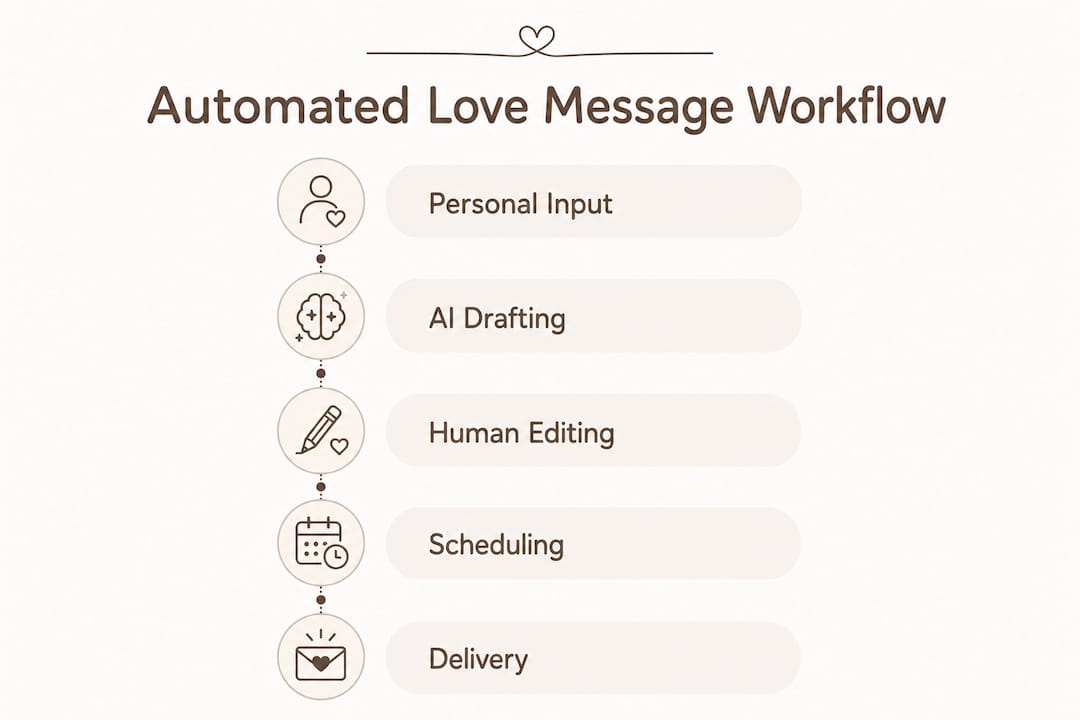
Modern automated messaging tools integrate with WhatsApp and Telegram via APIs, using databases like PocketBase for context retention and scheduled delivery. Tech stacks built for this purpose include Next.js, PocketBase, and Whapi.cloud, enabling deterministic daily messages that arrive through the platforms couples already use.
The scheduling logic in advanced systems goes beyond a simple timer. Proactive scheduling factors in your partner’s daily rhythms, recent communication, and potential stress periods to determine the optimal send time. The system avoids high-stress windows like back-to-back meetings and uses randomized intervals to sustain the feeling of spontaneity.
The four delivery methods available to couples today, ranked by technical complexity:
- Basic scheduler: A cron job or calendar trigger sends a pre-written message at a fixed time each day. Simple, reliable, and requires no AI.
- API-integrated scheduler: An LLM generates the message, and an API delivers it through WhatsApp or Telegram at a set time. Moderate setup, high output quality.
- Context-aware scheduler: The system reads recent messages, checks the partner’s time zone and calendar, then selects the best window and generates a context-relevant message.
- Multimedia scheduler: The system sends text alongside photos, stickers, or voice notes using real messenger infrastructure for greater intimacy and variety.
| Delivery method | Technical skill needed | Personalization level |
|---|---|---|
| Basic scheduler | Low | Low |
| API-integrated | Moderate | High |
| Context-aware | High | Very high |
| Multimedia | High | Very high |
The right choice depends on how much setup time you want to invest and how personal you need the output to feel. For most couples, an API-integrated scheduler hits the right balance between effort and impact.
How do you keep automated messages feeling genuine?
The biggest risk with automated romantic messages is not that they will feel robotic. The risk is that they will feel generic. Authentic romantic messages combine three elements: a shared memory, an emotional question, and a forward-looking thought. A message that includes all three reads as personal even if an AI drafted the first version.
“Automation should inspire human connection rather than replace it. The moment a message could have been sent to anyone, it stops working as a love message.”
Expert guidance consistently points to one practice that separates effective automation from outsourced affection: the human pass. The final human review and edit of AI-generated messages is what maintains authenticity and emotional truth. Editing adds unique real-world details only the couple would know, which is what makes the message believable.
Practical ways to keep automated messages from going stale:
- Rotate message categories: Gratitude, humor, nostalgia, anticipation, and encouragement each create a different emotional response. Cycling through them prevents predictability.
- Update your memory database monthly: Add new shared experiences, inside jokes, and milestones so the AI has fresh material to draw from.
- Avoid Hallmark language: Phrases like “you complete me” or “my heart is yours” signal generic output. Specific beats sentimental every time.
- Set a review cadence: Read through the last two weeks of sent messages before approving new ones. Repetition is the fastest way to erode impact.
Pro Tip: Write one sentence in your own words at the end of every AI-generated message. Even a single personal line shifts the entire tone from automated to intimate.
Meaningful romantic messages evoke emotion by referencing real-life shared moments and authentic feelings rather than idealized language. The AI handles the structure. You supply the truth.
What are the practical steps to set up your own system?
Setting up a working automated love message system takes one focused evening if you follow a clear sequence. The tools exist at every level of technical comfort, from no-code apps to custom API builds.
Start with these decisions before touching any tool:
- Message frequency: Daily messages work well for couples who text often. Three times a week suits partners who prefer space between check-ins.
- Delivery platform: Use the platform your partner already checks. A message on WhatsApp lands faster than one on a platform they open once a day.
- Memory inputs: Write down 10–15 specific details about your partner and relationship before you generate anything. This list becomes your personalization foundation.
- Approval workflow: Decide whether messages go out automatically or sit in a queue for your review. A review queue adds two minutes of effort and significantly improves quality.
For the AI layer, GPT-based APIs are the most accessible starting point. You write a system prompt that describes your partner, your relationship tone, and the message format you want. The API returns options you can schedule or approve. Personalized love tools built specifically for couples handle much of this setup automatically, removing the need to configure APIs or databases yourself.
The comparison that matters most when choosing a setup approach is not features. It is how much friction the system adds to your daily routine. A technically impressive setup you abandon after two weeks does less for your relationship than a simple one you maintain for six months. Short love messages sent consistently outperform elaborate ones sent occasionally.
Keep the system fresh by scheduling a monthly review. Add new memory inputs, retire message categories that have run their course, and adjust timing if your partner’s schedule has changed. Consistency and freshness together are what make the system feel like care rather than automation.
Key Takeaways
Automated love messages work best when AI handles the drafting and a human adds the personal detail that makes the message true.
| Point | Details |
|---|---|
| AI drafts, humans finish | LLMs generate options, but a personal edit is what makes each message land. |
| Memory drives personalization | Storing shared details in a database prevents generic output and keeps messages relevant. |
| Timing shapes impact | Early morning and evening are the highest-impact windows for romantic message delivery. |
| Consistency beats complexity | A simple system used daily does more for a relationship than a sophisticated one used rarely. |
| Authenticity requires structure | Effective messages combine a shared memory, an emotional question, and a forward-looking thought. |
Why I think the “authenticity” debate misses the point
Most of the public debate about automated love messages focuses on whether they are “real.” That framing is wrong. The question is not whether a machine helped you write the message. The question is whether the message is true.
I have watched couples use this technology in two very different ways. The first group treats it as a replacement for emotional effort. They generate messages, schedule them, and never look at them again. Those relationships do not improve. The second group uses automation the way a good writer uses an editor: to get past the blank page and into the real work of saying something meaningful.
The human pass editing step is not optional. It is the entire point. Every couple I have seen get real value from this technology treats the AI draft as a starting point, not a finished product. They add one line. They change a word. They make it theirs.
Technology supports emotional labor. It does not replace it. If you use automated messages to say things you genuinely feel but struggle to express consistently, the technology is working exactly as it should. If you use it to avoid feeling anything at all, no amount of scheduling will save the relationship.
— Alan
Pingher makes daily love messages effortless
Staying emotionally connected when life gets busy is one of the hardest parts of any relationship. Pingher is built specifically for couples who want to express love and appreciation every day without spending significant time or effort on each message.
With one-tap functionality, Pingher lets you craft and send personalized love messages that feel thoughtful rather than rushed. The platform combines convenience with a personal touch, so your partner receives messages that reflect your relationship, not a template. Pingher handles the delivery. You supply the intention. That combination is what keeps emotional connection strong over time.
FAQ
What is an automated love message?
An automated love message is an AI-generated romantic text sent on a schedule or triggered by specific conditions, designed to help couples maintain emotional connection consistently.
How do AI love message systems personalize content?
AI love message systems use memory databases to store partner-specific details, shared history, and communication preferences, which the LLM draws on to generate relevant, non-generic messages.
What is the best time to send automated romantic messages?
Early morning and evening are the highest-impact windows for romantic texts, as emotional receptivity is strongest when partners are starting or ending their day.
Do automated messages replace real emotional effort?
Automated messages work best as a drafting tool, not a replacement for genuine feeling. The human edit added to each AI draft is what maintains authenticity and emotional resonance.
How do I keep automated love messages from feeling repetitive?
Rotate message categories such as gratitude, humor, and nostalgia, update your memory database monthly with new shared experiences, and review sent messages regularly to avoid repeating the same themes.
Recommended
Built for couples who care.
Pingher helps you send the right words at the right moment.
Get Pingher on Google Play