How Feelings of Closeness Develop in Relationships

How Feelings of Closeness Develop in Relationships
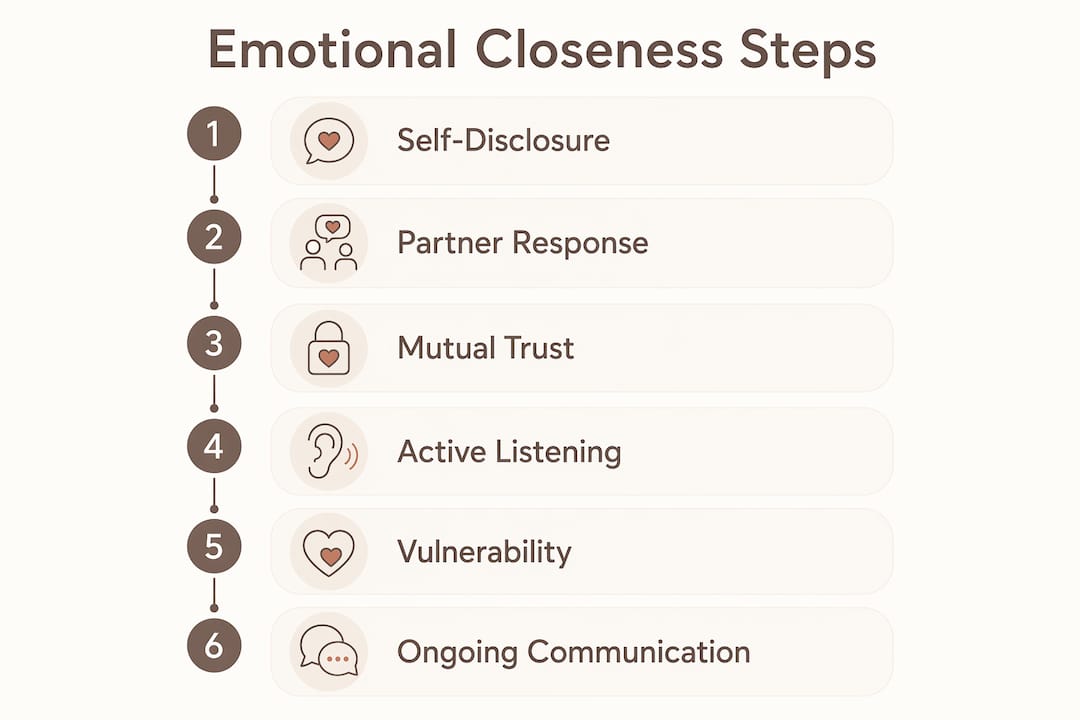
Feelings of closeness grow through a specific, repeatable process: one person shares something personal, the other responds with genuine interest and reciprocates, and over time that exchange builds trust, vulnerability, and mutual understanding. Psychologists call this reciprocal self-disclosure, and it is the engine behind nearly every deep relationship. Closeness does not arrive in a single breakthrough conversation. It accumulates through hundreds of small moments where you feel seen, heard, and valued by your partner.
The key mechanism researchers keep returning to is perceived partner responsiveness, which is the sense that your partner genuinely understands and cares about what you share. When that feeling is present, vulnerability feels safer, and intimacy deepens naturally.
A few core truths about how emotional closeness forms:
- It builds gradually, not all at once, through consistent and empathetic exchanges
- Reciprocal self-disclosure, where both partners share and respond, drives the process
- Perceived partner responsiveness is the organizing force that makes vulnerability feel safe
- Communication, trust, and vulnerability do not operate independently; each one reinforces the others
- Temporary disconnection is normal; what matters is whether couples have ways to repair it
Why emotional closeness matters in your relationship
Emotional closeness is not a nice bonus on top of a functional relationship. It is the foundation that determines how well a relationship handles stress, conflict, and change. Couples with strong emotional intimacy tend to resolve disagreements more effectively because they trust each other’s intentions even when they disagree on the facts.
The benefits extend well beyond conflict resolution. Emotional connection supports psychological well-being, reduces anxiety, and gives both partners a sense of security that makes daily life feel more manageable. Research on close relationships consistently links emotional intimacy to higher relationship satisfaction and greater resilience when life gets hard.
Closeness also shapes the quality of communication itself. When partners feel emotionally safe with each other, they are more likely to speak honestly, ask for what they need, and listen without defensiveness. Physical affection and shared activities matter, but without emotional intimacy underneath them, they tend to feel hollow over time.
What signs of emotional closeness actually look like
Recognizing closeness in a relationship is less about grand declarations and more about the texture of everyday interaction. The clearest sign is that both partners feel comfortable sharing things they would not tell most people, without worrying about judgment or ridicule.
Other reliable indicators include:
- Open, honest communication where both partners express feelings without fear of dismissal
- Active listening, meaning your partner tracks what you say, asks follow-up questions, and remembers details
- Mutual vulnerability, where both people share insecurities, not just one person carrying that weight
- Feeling understood and accepted, even when you reveal something unflattering about yourself
- Shared laughter and lightness, which signals comfort and genuine enjoyment of each other’s company
- Ability to sit with difficult emotions together, rather than one partner shutting down or deflecting
- Consistent small affections, like a text during the day or a hand on the shoulder, that signal ongoing attention
Trust and security show up in partner responsiveness. When you share something vulnerable and your partner responds with care rather than criticism, that response itself becomes evidence that closeness is real and growing.
How communication builds and deepens emotional closeness
Communication is the primary vehicle through which emotional intimacy travels. Sharing your thoughts, fears, and experiences openly gives your partner something real to respond to, and that response is where closeness either grows or stalls.

The most underrated communication skill in relationships is active listening. Not waiting for your turn to speak, but actually tracking what your partner is saying, reflecting it back, and asking questions that show you were paying attention. Validation matters here too. You do not have to agree with your partner’s feelings to acknowledge that those feelings make sense.
Psychologist John Gottman’s research introduced the concept of bids for connection, which are the small, often subtle attempts people make to engage their partner’s attention or affection. A comment about the weather, a funny observation, a sigh. Responding positively to these small emotional bids builds a steady baseline of trust that supports deeper intimacy over time. Ignoring or dismissing them consistently does the opposite.
Most couples default to surface-level conversation about logistics, schedules, and tasks. Shifting toward deeper exchanges requires intention.
Pro Tip: Try replacing one logistical conversation per day with a question that invites genuine reflection, something like “What’s been on your mind lately?” or “What are you looking forward to this week?” Tools like conversation cards can make this kind of shift feel natural rather than forced.
How vulnerability and trust work together to deepen intimacy
Vulnerability is the willingness to be authentically known, including the parts of yourself you are not entirely proud of. It is the act of saying “here is something real about me” without knowing for certain how your partner will respond. That uncertainty is precisely what makes it powerful.
Trust is what makes vulnerability feel survivable. Specifically, trust in this context means believing that what you share will not be used against you, mocked, or dismissed. Perceived partner responsiveness is a stronger predictor of closeness than the amount of time partners spend together, according to relationship research. You can spend every evening with someone and still feel emotionally distant if you never feel genuinely understood.
Mutual vulnerability is what separates emotional intimacy from one-sided emotional labor. When only one partner takes risks and shares deeply while the other stays guarded, closeness cannot fully form. Both people need to move through the discomfort of being seen.
Past trauma and fear of rejection are the most common barriers. If a previous relationship punished openness, the nervous system learns to protect itself by staying closed. Overcoming that takes gradual exposure: sharing something small, noticing that the response is safe, and slowly increasing the depth of what you share. Escalating self-disclosure incrementally, rather than forcing deep intimacy too early, is the approach that actually works.
Practical strategies to strengthen closeness in long-term relationships
Long-term relationships face a specific challenge: familiarity can quietly replace intentionality. The routines that once felt comforting start to crowd out the kind of deliberate connection that built closeness in the first place.
Consistent emotional check-in rituals are one of the most effective tools available. Research supports the value of a regular, dedicated window for emotional sharing, even a 30-minute weekly conversation where both partners talk about how they are feeling in the relationship, not just about what happened that week.
Other strategies that hold up over time:
- Shared new experiences: Novelty creates mild vulnerability and joint engagement, both of which accelerate closeness. Try something neither of you has done before, even something small.
- Daily small acts of affection: A thoughtful compliment or a brief affectionate message during the day signals ongoing attention without requiring a major time investment.
- Expressed appreciation: Naming specifically what you value about your partner, rather than offering generic praise, lands differently and registers as genuine.
- Maintained individuality: Closeness does not mean merging completely. Partners who preserve their own interests and friendships bring more to the relationship, not less.
- Ongoing curiosity: Assuming you already know everything about your partner is one of the quieter ways intimacy erodes. People change. Staying curious about who your partner is becoming keeps the connection alive.
Intentional daily conversations do not need to be long to be effective. What matters is that they are genuine.
How to rebuild emotional closeness after conflict or betrayal
Conflict does not destroy closeness by itself. What damages intimacy is how conflict is handled, specifically whether both partners feel heard and whether trust is repaired afterward. A relationship that navigates rupture and repair well often ends up more resilient than one that never gets tested.
Rebuilding after a serious breach, whether that is a betrayal of trust, a period of emotional withdrawal, or a damaging argument, requires a few specific things. First, open and honest communication about what happened and how it felt, without minimizing or deflecting. Second, genuine empathy from the partner who caused harm, not just an apology, but a demonstrated understanding of the impact.
Forgiveness is not the same as forgetting, and it does not happen on a schedule. What it does require is a decision to stop using the past as a weapon and a willingness to rebuild safety incrementally. Closeness fluctuates as both a state and a trait; temporary emotional distance after conflict is normal, not a sign that the relationship is broken.
Transparency and consistent trustworthy behavior over time are what actually restore the sense of safety that intimacy requires. There is no shortcut. The repair happens through repeated small moments of showing up, responding with care, and following through on what you say you will do.
What research tells us about how emotional closeness develops
The psychological literature on intimacy development converges on a few key findings that are worth knowing directly.
The foundational model is gradual, reciprocal self-disclosure: one person shares a personal detail, the partner responds with interest and their own disclosure, and this exchange builds intimacy cumulatively over time. The process is not linear, and it does not require dramatic revelations. It requires consistency and genuine responsiveness.
Psychologist Arthur Aron’s 36-question procedure demonstrated that structured, escalating personal exchange can accelerate closeness significantly in a short, intensive session. The questions move from light engagement to genuine vulnerability, followed by sustained eye contact. The result is a level of closeness that exceeds what most people experience in ordinary conversation. The mechanism is the same as long-term intimacy development, just compressed.
Research on shared challenges adds another dimension. Navigating difficulty together tends to build stronger mutual trust than shared positive experiences alone, because hard moments test and prove reliability in ways that easy ones cannot. Couples who support each other through genuine stress often report feeling closer afterward, not despite the difficulty, but because of how they handled it together.
Research insight: Perceived partner responsiveness, the confidence that your partner is genuinely committed to your well-being, is a stronger predictor of emotional closeness than the total time partners spend together.
Pingher is built around this insight. Its one-tap messaging platform makes it easy to send a personalized, thoughtful message to your partner during the day, the kind of small, responsive gesture that communication research consistently links to sustained emotional intimacy. Closeness does not require grand gestures. It requires showing up, consistently, in small ways that your partner actually feels.
Key Takeaways
Emotional closeness develops through reciprocal self-disclosure and perceived partner responsiveness, built gradually through consistent, empathetic communication rather than single dramatic moments.
| Point | Details |
|---|---|
| Reciprocal self-disclosure drives closeness | Sharing personal details and responding with genuine interest builds intimacy cumulatively over time. |
| Partner responsiveness predicts closeness | Feeling genuinely understood by your partner is a stronger predictor of closeness than time spent together. |
| Small bids for connection matter | Responding positively to a partner’s minor emotional cues builds the trust that supports deeper intimacy. |
| Vulnerability requires incremental steps | Escalating self-disclosure gradually, rather than forcing depth too early, creates emotional safety. |
| Closeness can be rebuilt after conflict | Repair happens through consistent trustworthy behavior, empathy, and transparent communication over time. |
Recommended
Built for couples who care.
Pingher helps you send the right words at the right moment.
Get Pingher on Google Play