How to Rebuild Connection After Relationship Silence

How to Rebuild Connection After Relationship Silence
The fastest way to rebuild connection after relationship silence isn’t a long, emotional conversation. It’s a single, low-pressure moment today, followed by another one tomorrow. A short plan built around safety signals, one honest repair attempt, and a small daily routine consistently outperforms any dramatic gesture.
Start here, in the next 24 hours:
- Put your phone face-down and sit near your partner for 10 minutes, no agenda, no pressure to talk.
- If they engage, stay present. If they don’t, that’s fine too. You’ve signaled safety, and that signal compounds.
Consistency beats intensity every time. Scheduling phone-free time and treating it as a real commitment moves couples out of logistics-only communication and back toward emotional closeness. That’s where this plan starts.
Table of Contents
- Why does silence start, and what does each partner feel?
- A three-step plan to restore your relationship after silence
- Scripts, micro-moments, and exercises you can use tonight
- When is silence a red flag, and when do you need professional help?
- How Pingher helps you keep the reconnection habits going
- Key Takeaways
- The part most couples miss
- Pingher makes daily reconnection easier for busy couples
Why does silence start, and what does each partner feel?
Silence in a relationship usually falls into one of two categories, and confusing them leads to the wrong response.
Protective shutdown happens when one partner’s nervous system becomes flooded. Heart rate spikes, thinking narrows, and withdrawal is physiological, not strategic. The person going quiet isn’t punishing anyone. They genuinely cannot process more input.
The silent treatment is different. It’s sustained, deliberate, and used to signal displeasure or exert control. Therapists distinguish it clearly: a healthy timeout is announced and time-bound with a plan to return. The silent treatment has no such structure.
The same silence feels completely different depending on which side you’re on. The partner who’s been shut out typically experiences anxiety, rejection, and a compulsion to pursue. The partner who withdrew feels overwhelmed and needs space to regulate. Clinicians emphasize that both experiences are valid simultaneously, and neither person is simply “the problem.”
Use this quick checklist to identify your pattern:
- Did the silence start after a specific conflict or gradually over weeks?
- Is there a clear return signal (a text, a look, a touch) or none at all?
- Does the quiet partner return when they’ve calmed down, or only when the other partner backs off?
- Has the silence been used repeatedly as a response to disagreement?
If the last two apply, you’re likely dealing with a control dynamic rather than overwhelm.
Pro Tip: If you feel your heart racing during conflict, try the physiological sigh: two short inhales through the nose, then one long exhale through the mouth. Research on stress regulation shows this activates the parasympathetic nervous system faster than a single deep breath.
A three-step plan to restore your relationship after silence
The structure is simple: Safety first, then Repair, then Routine. A practical 4-week framework breaks this into measurable stages.
Safety: reduce the threat before you talk
Walk side-by-side rather than face-to-face for difficult conversations. Announce any timeout with a specific return time (“I need 30 minutes. I’ll come back at 8 PM”). Never leave without that return commitment. Gottman research confirms that visible pauses with promised return times are central to successful repair.
Repair: one honest conversation
Keep it short. Three turns each, maximum. Use this structure:
- Name the cycle, not the person: “We got into that pursuer-withdrawer loop again.”
- State impact without accusation: “When you went quiet, I felt scared we were losing each other.”
- Offer a do-over: “Can we try that conversation again, differently?”
Routine: small habits that compound
Trust rebuilds through consistent follow-through, not through single heroic moments. A 6-second kiss at departure, a 10-minute nightly check-in, and one appreciation per day are more effective than a weekend getaway that’s followed by two weeks of emotional distance.
| Week | Focus | Daily Action | Progress Marker |
|---|---|---|---|
| 1 | Safety signals | 10-min phone-free sit-together | Partner stops flinching at your approach |
| 10 minutes | Repair attempt | One structured repair conversation | Both partners name the cycle without blame |
| one | Micro-habits | 6-second kiss + nightly check-in | Fewer defensive reactions during small talk |
| 4 | Novelty + review | One new shared activity | Laughter returns; bids for connection increase |
Scripts, micro-moments, and exercises you can use tonight
These are copy-ready. Adjust the wording to fit your voice.
Three repair scripts:
- Re-entry after silence: “I’m back. I’m sorry I went quiet. I wasn’t ready to talk, but I didn’t want you to feel abandoned.”
- Validating their experience: “I can see that my silence hurt you. That makes sense. You needed me to show up and I didn’t.”
- Do-over apology: “I said that badly. Can I try again?”
Micro-moments are brief, clinician-recommended gestures that rebuild safety in under a minute. A 7-second hug (long enough to trigger oxytocin release), a single appreciative sentence before bed, or a mid-day text that asks one genuine question. None of these require a conversation. They just require showing up.
Structured self-disclosure exercises like the Gottman Love Maps and the original 36 Questions by Aron et al. help partners update their mental model of each other, especially after distance. You don’t need all 36. Start with two or three.
Try these tonight (20 minutes, no phones):
- “What’s one thing you’ve been thinking about lately that I probably don’t know?”
- “What’s something you appreciated about me this week, even if you didn’t say it?”
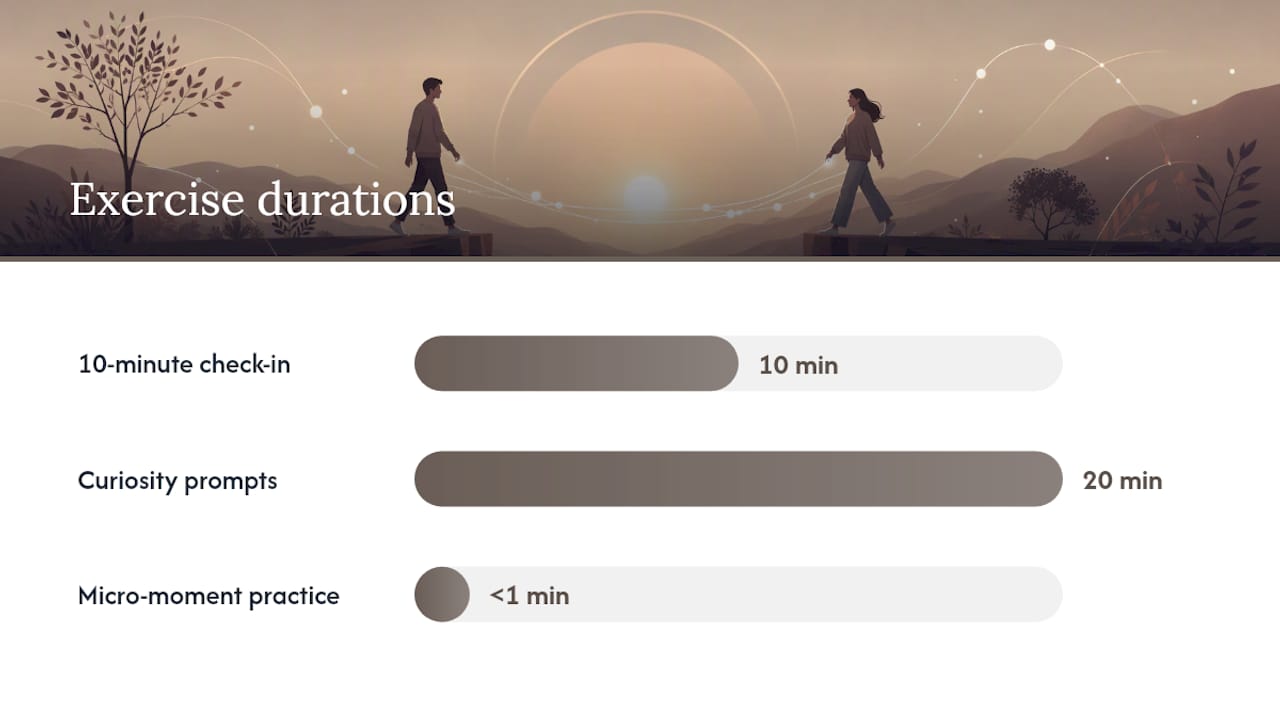
| Exercise | Duration | Format | Best Used |
|---|---|---|---|
| 10-minute check-in | 10 minutes | Each partner shares one high, one low | Nightly, after kids are in bed |
| Curiosity prompts | 20 min | 10 minutes–one open questions, no advice-giving | Weekend mornings |
| Micro-moment practice | Under 1 min | Hug, kiss, or one-sentence appreciation | Daily, any time |
When is silence a red flag, and when do you need professional help?
Some patterns are beyond what a self-guided plan can fix.
Seek professional support when:
- Silences last more than a week and happen repeatedly after any conflict.
- One partner uses silence alongside threats, financial control, or isolation from friends and family.
- You feel afraid to bring up certain topics because of how your partner will respond.
- Reconnection attempts are consistently met with contempt or dismissal.
- Either partner is experiencing depression, anxiety, or trauma responses tied to the relationship.
When silence is used as a control tactic, it crosses from communication breakdown into emotional abuse. The distinction matters because the repair approach is completely different. A therapist can help you tell them apart.
For couples therapy in the U.S., the American Association for Marriage and Family Therapy (AAMFT) directory and Psychology Today’s therapist finder are both reliable starting points. For individual support, the SAMHSA National Helpline (1-800-662-4357) is free and available 24/7.
Pro Tip: If you’re concerned about escalation, start documenting patterns privately: dates, what was said, how long the silence lasted. This record is useful for a therapist and, if needed, for a safety plan.
How Pingher helps you keep the reconnection habits going
The hardest part of any reconnection plan isn’t the first week. It’s week three, when life gets busy and the micro-habits slip.
Pingher is built for exactly that gap. Its core features map directly onto the Safety → Repair → Routine plan:
- Habit reminders: Set a daily nudge for your nightly check-in or your morning appreciation. Reminders improve relationship health by keeping the habit visible when motivation fades.
Two practical examples: A partner who travels for work can schedule three appreciation messages across the week so their partner never goes more than two days without a warm signal. A partner recovering from a conflict can use a template to send a low-pressure re-entry message without the anxiety of composing it from scratch.
Pingher is available in the U.S. via Google Play and the App Store.
Key Takeaways
Rebuilding connection after relationship silence works when you prioritize safety signals first, make one honest repair attempt, and build small daily habits that compound over weeks, not days.
| Point | Details |
|---|---|
| Safety before repair | Announce timeouts with a return time; walk side-by-side for hard talks to reduce physiological threat. |
| Name the cycle | Use “pursuer-withdrawer” framing to describe the pattern without blaming either partner. |
| Consistency over intensity | A daily 10-minute check-in and one appreciation outperform a single long conversation. |
| Know when to get help | Repeated silences tied to control, fear, or contempt require a licensed therapist, not a self-guided plan. |
| Use Pingher to sustain habits | Schedule micro-messages and set habit reminders so the routine survives busy weeks. |
The part most couples miss
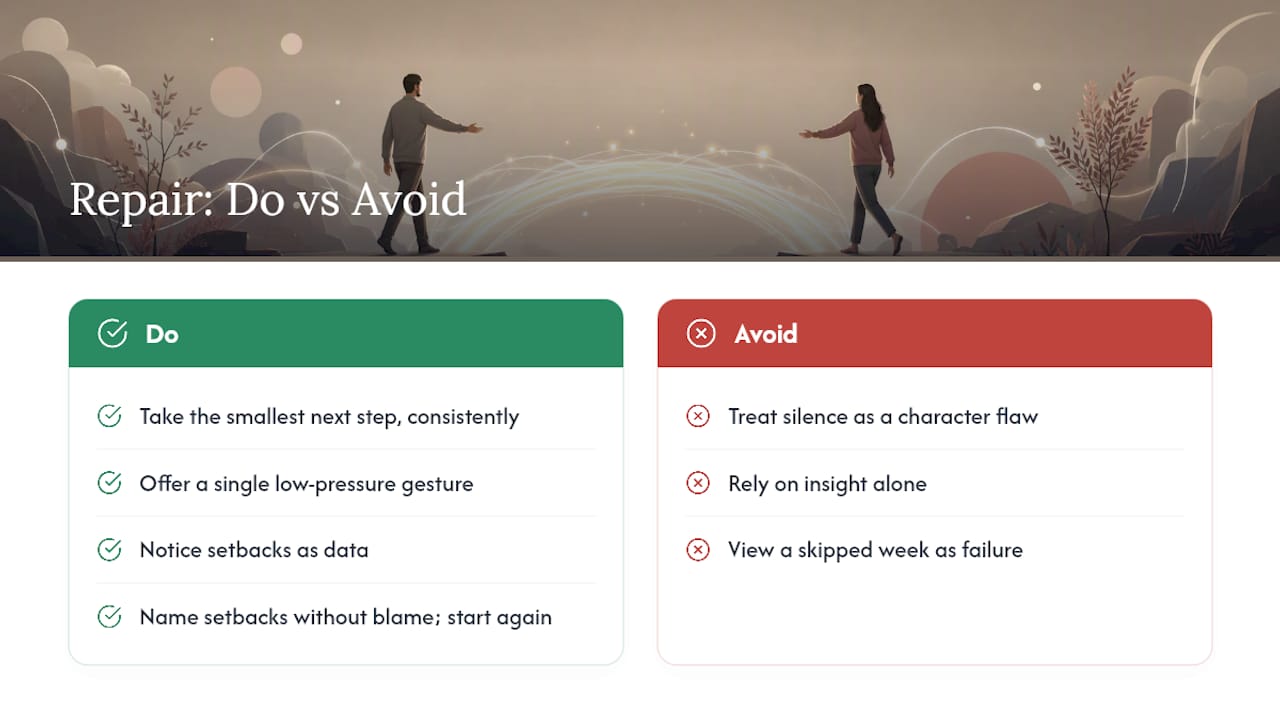
Silence after conflict isn’t a character flaw. It’s a nervous system response, and for most couples it’s been building for months before it becomes a pattern. The research on repair, from Gottman’s lab to clinical work on emotional withdrawal, points to the same conclusion: the couples who come back from long silences aren’t the ones who had the most insight. They’re the ones who took the smallest next step, consistently, even when it felt awkward.
What I’ve seen in 20 years of writing about and researching relationship dynamics is that people underestimate how much a single low-pressure gesture does. Not because it solves anything on its own, but because it changes the story both partners are telling themselves about whether repair is even possible. That shift, from “we’re broken” to “we’re trying,” is where reconnection actually begins.
Setbacks are part of the process. A week where you skip the check-in isn’t a failure. It’s data. Notice it, name it without blame, and start again. Progress is measured by how quickly you return, not by whether you ever slip.
Pingher makes daily reconnection easier for busy couples
Knowing what to do and actually doing it on a Tuesday night after a long workday are two different things. That’s the gap Pingher closes.

Pingher is a mobile app built for couples who want to stay emotionally connected without adding another task to an already full day. You write a message once, schedule it, and it arrives at exactly the right moment, whether that’s a morning “thinking of you” or a repair note sent an hour after a hard conversation. The AI-assisted templates mean you’re never staring at a blank screen trying to find the right words. The one-tap send means a micro-moment takes five seconds, not five minutes.
For partners working through thoughtful digital communication after a period of silence, Pingher removes the friction that makes good intentions fall apart. It’s not a substitute for the repair conversation. It’s what keeps the warmth alive between those conversations.
Download Pingher and schedule your first message this week. One small signal, sent consistently, is where reconnection starts.
Recommended
Built for couples who care.
Pingher helps you send the right words at the right moment.
Get Pingher on Google Play