How Communication Shapes Relationship Health and Trust

How Communication Shapes Relationship Health and Trust
Clear, responsive communication is the primary mechanism that builds trust, deepens intimacy, and makes conflict repair possible between partners. Research published in peer-reviewed literature consistently links a 5:1 ratio of positive to negative interactions with lasting relationship satisfaction. The Gottman Institute’s concept of “bids for connection” adds a practical layer: most of what partners need isn’t grand gestures, it’s small, consistent responses to everyday moments of reaching out.
Start here, today:
- Notice bids. When your partner mentions something, even casually, that’s a bid for connection. Turning toward it, even briefly, builds trust faster than any single conversation.
- Practice active listening. Full attention, no phone, reflect back what you heard before responding.
- Send one appreciation message daily. A single specific, genuine message shifts the daily ratio toward positive. Pingher makes this a one-tap habit.
Pro Tip: You don’t need a long conversation to strengthen connection. A two-sentence text that names something specific you appreciate about your partner can move the needle more than a weekly “relationship talk” that stays surface-level.
Table of Contents
- Why does communication matter for relationship health?
- What does communication actually include in a relationship?
- How to listen so your partner actually feels heard
- What communication patterns damage relationships most?
- How to use communication to resolve conflict and repair harm
- Daily habits that actually shift your communication patterns
- When should you get outside help for communication problems?
- What does the research actually say about communication and relationships?
- Key Takeaways
- Small changes, compounded over time
- Pingher helps you stay connected between the big conversations
- Useful sources and further reading
Why does communication matter for relationship health?
Communication doesn’t just help relationships run smoothly. It’s the actual mechanism through which trust, emotional safety, and intimacy are built or eroded, day by day.
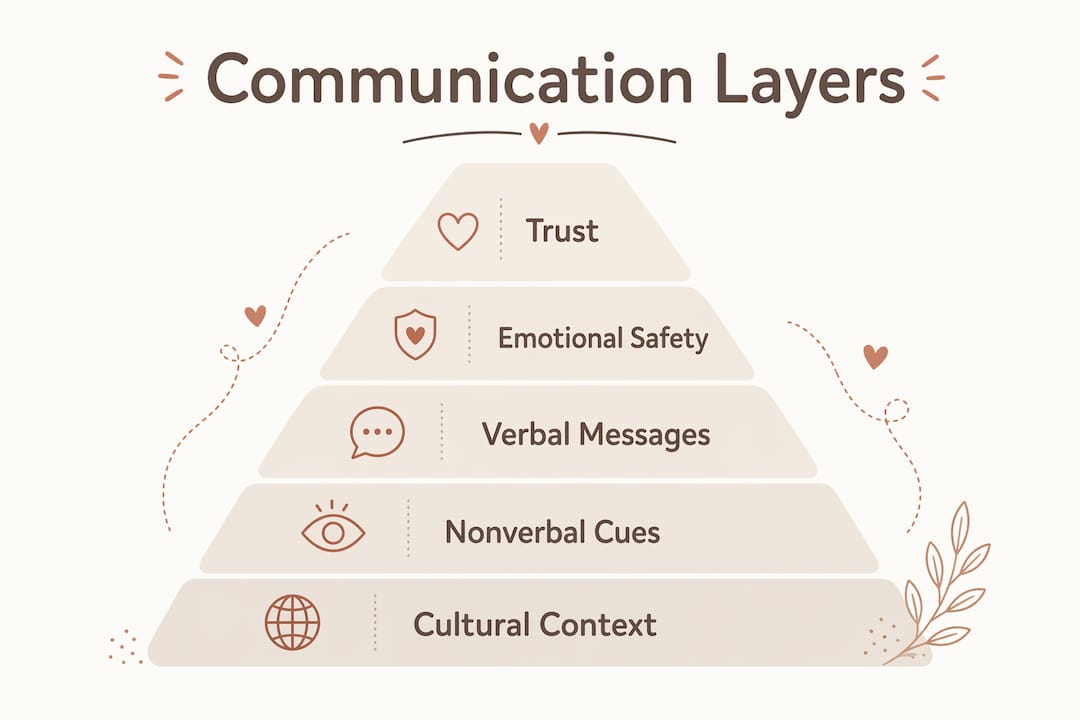
Trust grows through consistency. When partners communicate transparently about needs, feelings, and intentions, they create a track record of reliability. Repair attempts, those moments when one partner reaches out after a conflict to restore connection, are only possible when both people feel safe enough to speak. Without that safety, partners stop trying.
Intimacy works differently than most people expect. It’s less about romantic moments and more about self-disclosure and what researchers call capitalization: actively sharing good news and responding constructively when your partner shares theirs. A partner who lights up when you tell them something went well at work creates a very different emotional environment than one who nods and changes the subject. Capitalization predicts relationship well-being above and beyond how well couples manage conflict.
The 5:1 ratio: Research associates a ratio of five positive interactions for every one negative interaction with sustained relationship satisfaction. This doesn’t mean avoiding all conflict. It means the daily texture of a relationship, the small appreciations, the moments of humor, the quick check-ins, needs to outweigh the friction by a meaningful margin.
Poor communication does real damage, and not just during arguments. Rumination on unresolved conflicts, emotional withdrawal, and escalation cycles all trace back to communication breakdowns. When partners stop feeling heard, they stop reaching out. That withdrawal is often the beginning of a slow decline in satisfaction, not a dramatic rupture.
- Consistent transparency builds a track record of reliability
- Capitalization (responding actively to good news) predicts intimacy beyond conflict management
- Unresolved negative cycles drive emotional distance and satisfaction decline
What does communication actually include in a relationship?
Most people think of communication as the conversations they have. The reality is broader, and recognizing all of it is where real change starts.

Verbal communication covers the words you choose and how you frame them. “I felt hurt when plans changed last minute” lands differently than “You always cancel on me.” The first opens a conversation; the second triggers defense. I-statements are the simplest verbal tool most couples underuse.
Nonverbal communication often carries more weight than words. Tone of voice, eye contact, posture, and physical touch all send messages that words can contradict. You can say “I’m fine” with crossed arms and a flat voice, and your partner will believe the body, not the sentence.
Listening is its own skill, and communication is a two-way process that most people underestimate on the receiving end. Passive hearing, waiting for your turn to talk, is not the same as active listening. The difference shows up in whether your partner feels understood or just processed.
Digital communication adds a layer of complexity. Texts and messages strip out tone, timing, and facial expression. A short reply that reads as dismissive might just be someone in a meeting. Context matters enormously, and so does the habit of following up a difficult text exchange with a real conversation.
“Effective communication is less about finding the right words and more about creating the conditions where both people feel safe enough to be honest.” — HelpGuide
Cultural and individual differences shape all of this. Some people express care through action rather than words. Others need explicit verbal affirmation to feel loved. Neither is wrong, but assuming your partner communicates the way you do is one of the most common sources of misreading. For practical examples of thoughtful digital messages that account for tone and timing, Pingher’s blog offers concrete starting points.
How to listen so your partner actually feels heard
Active listening is consistently ranked as more important than speaking clearly, because it’s what makes a partner feel valued rather than just responded to. Here’s how to do it in practice:
- Prepare. Put the phone down. Make eye contact. Signal with your body that this conversation has your full attention. Even 60 seconds of genuine presence changes the quality of what follows.
- Reflect. After your partner speaks, mirror back the core of what you heard before adding your own response. “What I hear you saying is that you felt left out when I didn’t mention the plans. Is that right?” This one step prevents more arguments than almost anything else.
- Validate. Acknowledge the feeling, even if you see the situation differently. “That makes sense, given what you were expecting” is not agreement; it’s recognition. Partners who feel validated are far less likely to escalate.
- Clarify. Ask one open question if something is unclear. “Can you tell me more about what that felt like?” works better than “Why did you think that?” because it invites rather than interrogates.
- Respond. Only now, after you’ve reflected, validated, and clarified, share your own perspective. Starting here, at step five, is what separates a conversation from a debate.
I-statements and soft start-ups belong in this same toolkit. “I felt anxious when I didn’t hear back” keeps the focus on your experience. “You never respond” puts your partner on trial. The first creates space; the second closes it.
- Use “What I hear you saying is…” to reflect before responding
- Validate feelings before offering your perspective
- Ask open questions (“Can you tell me more?”) rather than closed or leading ones
Pro Tip: Nonverbal cues often tell you more than the words do. If your partner’s voice tightens or they look away, that’s information. Naming it gently, “You seem like something’s bothering you beyond what you’re saying,” opens more than pressing for details.

What communication patterns damage relationships most?
Knowing what to do helps. Knowing what to stop doing is often faster. These patterns show up in most struggling relationships, and recognizing them early is the leverage point.
- Defensiveness. Responding to a concern with a counter-complaint or justification. It signals that self-protection matters more than understanding. Example: “I feel like you’ve been distant lately” met with “Well, you’re always on your phone.”
- Criticism. Attacking character rather than addressing behavior. “You’re so selfish” versus “I felt overlooked when you made that decision without me.” One shuts the conversation down; the other keeps it open.
- Stonewalling. Shutting down entirely, going silent, leaving the room. It often comes from emotional flooding, but the effect on the other partner is abandonment. Repeated stonewalling is one of the strongest predictors of relationship deterioration.
- Mind-reading. Assuming you know what your partner meant without checking. Habitual mind-reading increases the risk of misinterpretation and cycles of criticism and defensiveness. The fix is simple: ask.
- Negative reciprocity. Matching a partner’s negativity with your own. One sharp comment leads to another, and within minutes the original issue is buried under accumulated grievances.
- Distractedness. Half-listening while scrolling or watching TV. Partners notice, and it communicates that the conversation isn’t worth full attention.
A note on cultural context: low verbal expressiveness isn’t always withdrawal. In some cultural backgrounds, silence or restraint signals respect or care, not disengagement. Before labeling a pattern as stonewalling, it’s worth asking whether the behavior is consistent with how your partner has always communicated, or whether it’s a new response to conflict specifically.
When stonewalling or criticism becomes the default response to every difficult topic, and repair attempts consistently fail, that’s a signal to bring in outside support rather than keep trying the same approaches.
How to use communication to resolve conflict and repair harm
Conflict isn’t the problem. How it starts and whether it gets repaired is what determines whether a disagreement damages the relationship or strengthens it.
Soft start-up is the single most effective way to open a difficult conversation without triggering defensiveness. It means leading with your feeling and a specific situation, not a verdict about your partner’s character.
Here’s a repair sequence that works:
- Acknowledge. Name what happened without blame. “I know things got heated last night.”
- Apologize. Specifically. “I’m sorry I raised my voice. That wasn’t fair to you.”
- Explain. Share your experience without making it an excuse. “I was already stressed, and I didn’t handle it well.”
- Propose repair. Offer something concrete. “Can we talk about the actual issue now, when we’re both calmer?”
- Check understanding. “Does that make sense? Is there anything you need from me right now?”
Repair attempts don’t have to be elaborate. A touch on the arm, a “hey, I don’t want to fight about this,” or even a shared laugh mid-argument can interrupt an escalation cycle. The speed of repair matters as much as the repair itself. A couple that can move from conflict back to warmth within an hour is in a very different place than one where tension lingers for days.
- Use “I felt…” to open difficult topics, not “You always…”
- Small repair bids (a touch, a joke, a direct “I’m sorry”) work faster than long apologies
- If repair attempts are consistently rejected or ignored, that pattern warrants professional attention
When repair fails repeatedly, it’s not a sign that the relationship is over. It’s a sign that the tools available aren’t enough, and that a couples therapist can provide the structure both partners need.
Daily habits that actually shift your communication patterns
Skills practiced once don’t stick. The research on daily communication practices is clear: simple, repeated habits move the needle more than occasional deep conversations.
Daily micro-habits:
- An evening appreciation: one specific thing you noticed about your partner today
- “What went well” sharing: each partner names one good thing from their day, and the other responds actively
- A 10-minute undistracted check-in, phones in another room, no agenda beyond connection
A 4-week practice plan:
- Week 1: Notice bids. Every time your partner says something, even offhand, treat it as a bid for connection. Respond with at least a word or a look. Track how often you catch yourself turning away.
- Week 2: Reflective listening. In every meaningful conversation, reflect before responding. Use “What I hear you saying is…” at least once per exchange.
- Week 3: Capitalization. When your partner shares good news, stop what you’re doing and respond actively. Ask a follow-up question. Celebrate with them, even briefly.
- Week 4: Repair practice. After any friction, initiate a repair within 24 hours. Use the five-step sequence. Notice how quickly the tension resolves compared to earlier weeks.
For verbal appreciation specifically, the most effective messages are specific rather than generic. “I appreciate how patient you were with me this morning” lands differently than “You’re great.”
Pro Tip: Tech nudges work when they’re low-pressure. A scheduled reminder to send one appreciation message, or a morning prompt to think of one thing you’re grateful for about your partner, costs almost nothing and keeps the habit alive on days when life gets busy. Pingher is built exactly for this: one tap, one meaningful message, no friction.
When should you get outside help for communication problems?
Self-directed practice works for most couples who are motivated and whose patterns haven’t become entrenched. But there are clear signals that outside support is the right call.
Decision checks:
- Repair attempts are consistently met with silence, contempt, or escalation
- One or both partners feel emotionally unsafe during conversations
- Conflict has escalated to any form of verbal, emotional, or physical harm
- Stonewalling or withdrawal has become the default response to any difficult topic
- You’ve tried structured practices for 4–8 weeks with no meaningful change
Suggested timeline:
- Try the structured practices in this article for 4–8 weeks with genuine effort from both partners.
- If patterns haven’t shifted, consider a couples communication workshop or a short coaching engagement.
- If safety is a concern at any point, contact the National Domestic Violence Hotline (1-800-799-7233) or a local crisis resource immediately.
Cost ranges in the U.S.:
- Couples therapy with a licensed therapist: typically $100–$250 per session, though this varies widely by location and provider. Many therapists offer sliding-scale fees, and some insurance plans cover a portion of the cost.
- Online couples therapy platforms: often lower per-session cost, with subscription models available.
- Workshops and communication courses: range from free (community mental health centers) to several hundred dollars for structured weekend programs.
This article is general information, not professional advice. For your specific situation, consult a licensed mental health professional or couples therapist.
What does the research actually say about communication and relationships?
The evidence base here is stronger than most people realize, and a few findings stand out as genuinely worth knowing.
The 5:1 ratio in practice: A peer-reviewed PMC study associates five positive interactions for every one negative interaction with sustained relationship satisfaction. This ratio isn’t about suppressing conflict. It’s about whether the daily texture of a relationship, small appreciations, humor, responsiveness, outweighs the friction.
Key research takeaways:
- Active listening matters more than eloquence. Giving full attention without interrupting is consistently rated as more important than speaking clearly, because it’s what makes a partner feel heard rather than managed.
- Capitalization is underused. Responding actively to positive news predicts relationship well-being above and beyond conflict management. Most couples focus on fixing problems and neglect celebrating wins together.
- Response style shapes satisfaction. Active-constructive responses to a partner’s good news correlate strongly with relationship satisfaction across cultures. Passive or dismissive responses erode it.
- Bids for connection are the daily currency. Missing bids because of distraction or stress is a common pathway to slow relationship deterioration. Training attention to small bids is one of the highest-leverage changes a couple can make.
Trusted sources for further reading: the Gottman Institute’s research blog, the PMC study on capitalization and accommodation, and Verywell Mind’s communication overview all offer well-grounded starting points.
Pingher fits into this picture as a habit-support tool, not a replacement for skill practice. Its one-tap messaging function makes it easy to send a specific appreciation message, schedule a check-in after a disagreement, or keep the daily positive ratio moving in the right direction. Two use cases where it adds real value: sending a brief “I noticed you today” message during a busy workday, and setting a reminder to initiate a repair check-in 24 hours after a conflict. Neither replaces the conversation, but both make it more likely to happen.
Key Takeaways
Strong communication is the daily practice of noticing, responding, and repairing, not a single skill but a set of habits that compound over time into trust and intimacy.
| Point | Details |
|---|---|
| The 5:1 ratio is your target | Aim for five positive interactions for every negative one to sustain relationship satisfaction. Research published in peer-reviewed literature consistently links a 5:1 ratio of positive to negative interactions with lasting relationship satisfaction. |
| Active listening beats eloquence | Reflecting back what you heard before responding makes partners feel heard and reduces defensiveness. |
| Capitalization builds intimacy | Responding actively to your partner’s good news predicts relationship well-being beyond conflict management. |
| Repair early and specifically | A targeted apology within 24 hours resolves tension faster than waiting for the “right moment.” |
| Pingher supports daily habits | One-tap appreciation messages and scheduled check-in reminders help sustain the positive ratio without effort. |
Small changes, compounded over time
The couples who communicate well aren’t the ones who never argue. They’re the ones who’ve gotten good at noticing small moments and responding to them, even imperfectly.
What the research keeps pointing to is that the gap between a struggling relationship and a satisfying one is often less about dramatic conversations and more about the texture of ordinary days. Whether a partner turns toward a bid or away from it. Whether good news gets celebrated or acknowledged with a nod. Whether a repair attempt lands or gets ignored.
The conventional advice, “just communicate more,” misses this entirely. More talking without better listening, or more conversations without repair, doesn’t move the needle. What moves it is quality and consistency: a daily appreciation that’s specific, a repair that comes quickly, a response to good news that shows you actually stopped to listen.
Mistakes are part of this. Missing a bid, responding defensively, forgetting the repair, none of that undoes the progress of consistent practice. The goal isn’t a perfect ratio every day. It’s a direction of travel that both partners can feel.
Pingher helps you stay connected between the big conversations
Most of the work of building a strong relationship happens in the small moments between the meaningful conversations. A quick message that names something specific you love about your partner. A check-in after a rough day. A reminder that you’re thinking of them, even when life is busy.
Pingher is built for exactly that. With one tap, you can send a personalized, thoughtful message to your partner without drafting something from scratch or finding the right words under pressure. The app is designed around the habits that research links to relationship satisfaction: daily appreciation, active acknowledgment, and consistent small gestures that keep the positive ratio moving in the right direction.
Two ways couples use it: sending a brief appreciation message during the workday to maintain connection, and scheduling a gentle check-in reminder 24 hours after a disagreement to prompt repair before tension hardens. Neither replaces the deeper conversations or professional support when it’s needed. Both make those conversations more likely to happen.
Start sending messages that matter and see how a small daily habit shifts the feel of your relationship over four weeks.
Useful sources and further reading
These are the primary sources behind the research and skills in this article:
- Communication, the Heart of a Relationship (PMC) — Peer-reviewed study on capitalization, accommodation, and the 5:1 ratio; the strongest empirical foundation in this article.
- Gottman Institute: Improve Communication in a Relationship — Practitioner-facing guidance on bids for connection and turning toward; grounded in decades of couples research.
- Gottman Institute: 5 Ways to Communicate Better — Practical scripts for soft start-up and repair attempts.
- Verywell Mind: Communication in Relationships — Accessible overview of outcomes and improvement strategies; good starting point for readers new to the topic.
- PositivePsychology.com: The Power of Communication Skills — Research summary on active listening and its role in connection.
- HelpGuide: Effective Communication — Practical mindset reframes and skill drills for reducing communication anxiety.
- Better Health Channel: Relationships and Communication — Clear, evidence-informed overview of daily communication habits and their effects.
- Pingher Blog: Why Communication Tools Support Relationships That Last — Explores how lightweight digital habits and reminders support trust and satisfaction over time.
- Pingher Blog: Thoughtful Message Ideas for Partners — Concrete message templates and prompts for daily appreciation and repair check-ins.
Recommended
Built for couples who care.
Pingher helps you send the right words at the right moment.
Get Pingher on Google Play