Short Love Messages With Big Relationship Impact

Short Love Messages With Big Relationship Impact
Short love messages are concise, specific expressions of affection that consistently outperform grand romantic gestures in building lasting emotional connection. You don’t need a long letter or a special occasion. A single sentence sent on an ordinary Tuesday can do more for your relationship than a Valentine’s Day speech. Research on couples confirms that small, habitual acts of appreciation predict long-term stability far better than rare, intense displays. Short love messages with big relationship impact are not a trend. They are one of the most reliable tools couples have for staying emotionally close.
Why do short love messages have such a big relationship impact?
The psychology behind concise romantic texts is clearer than most people expect. Behavioral researchers use the term “bids for connection” to describe small, unsolicited gestures that signal emotional availability. A text saying “thinking of you” or “made it home safe” is a bid. Turning toward these bids consistently is one of the strongest predictors of relationship closeness over time. That single check-in text carries more relational weight than most couples realize.
Specificity is the other key ingredient. Saying “I love you” is warm, but it is also easy to tune out after years of repetition. Describing why you love someone, tied to a real, observable behavior, creates a different emotional response entirely. Specific appreciation for something your partner actually did makes them feel genuinely seen, not just loved in a general sense. That distinction matters more than most couples acknowledge.
“Love messages sent at random, ordinary times are the strongest indicators of genuine attention.” — relationship communication researchers
Timing also shapes impact. Messages sent without any external trigger, no anniversary, no argument to repair, no special event, carry a different signal. They say: I thought of you because I wanted to, not because I had to. Spontaneous messages on ordinary days demonstrate unprompted attention, and that is the kind of attention that builds trust over months and years.
The brain processes short messages in 2–3 seconds, and that speed matters. Short emotional messages trigger faster, stronger positive reactions than long texts, and the memory of them tends to stick. A brief message lands before the reader has time to overthink it. That immediacy is a feature, not a limitation.
Consistency beats intensity every time. A study analyzing over 40,000 couples over 50 years found that consistent gratitude for specific daily acts is a key predictor of long-term relationship warmth. Grand gestures feel good in the moment, but they fade. Daily noticing builds a living, responsive emotional system between two people.
What tools and methods work best for sending love messages?
Couples have three main channels for short sweet messages: digital texts, handwritten notes, and verbal check-ins. Each works differently, and the best choice depends on your relationship style and daily rhythm.

| Channel | Strengths | Limitations |
|---|---|---|
| Digital text | Instant delivery, easy to send anytime | Can feel low-effort if overused |
| Handwritten note | Tangible, signals deliberate effort | Requires planning and placement |
| Verbal check-in | Warm, personal, immediate | Requires both partners to be present |
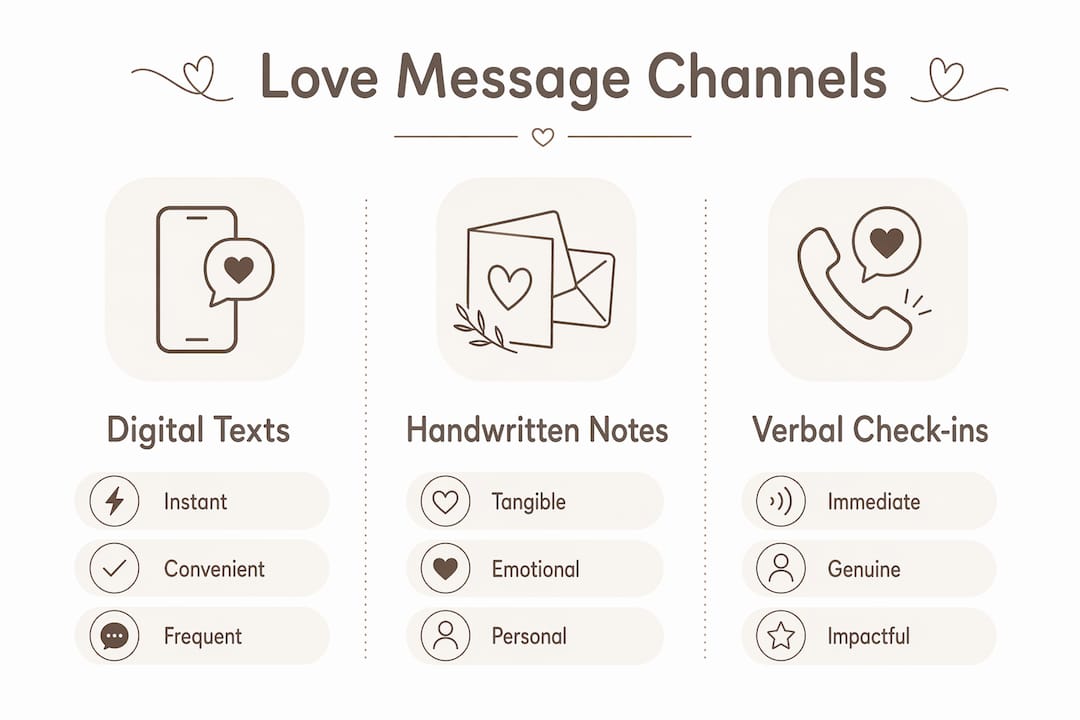
Digital texts win on convenience. You can send a message from across the country in seconds, and most people check their phones frequently enough that the message lands quickly. The risk is that texts can start to feel automatic, especially if you send the same phrases every day.
Physical love notes placed in unexpected locations carry greater emotional weight than digital messages because the effort is visible. Finding a note tucked into a jacket pocket or left on the bathroom mirror signals that your partner thought about you before you were even awake. Imperfect handwriting is not a problem. The tangible effort is the point.
Verbal check-ins are underrated. A quick “I noticed how hard you worked today” said at dinner costs nothing and lands immediately. The limitation is that both partners need to be present and in the right headspace, which is not always guaranteed.
Pro Tip: Use a mix of all three channels across the week. Rotate between a morning text, a handwritten note slipped somewhere unexpected, and a verbal acknowledgment at dinner. Variety keeps the messages feeling fresh and deliberate.
Apps like Pingher are built specifically for couples who want to maintain consistent loving communication without relying on memory or willpower. Pingher offers one-tap message sending and curated templates, so you can stay emotionally present even on your busiest days. The goal is not to automate love. The goal is to remove the friction that stops you from expressing it.
Authenticity matters more than polish. A message with a typo that comes from a real moment beats a perfectly worded text that feels generic. Your partner knows your voice. Write in it.
How to craft love messages with meaning: examples and best practices
Impactful love notes follow a simple pattern: one specific observation, one honest feeling, and no filler. That structure works across every tone, whether romantic, playful, or supportive.
A step-by-step approach to writing short messages
- Pick one specific moment or behavior. Not “you’re amazing” but “the way you handled that phone call this morning was impressive.”
- Name how it made you feel. “It reminded me why I trust you completely.”
- Keep it under three sentences. Brevity signals confidence. You don’t need to over-explain.
- Send it without waiting for the perfect moment. Ordinary timing is the point.
- Vary your tone across the week. Rotate between romantic, playful, and supportive messages.
Here are examples across different situations:
- Daily check-in: “Thinking about you between meetings. Hope your day is going well.”
- Encouragement: “You’ve been carrying a lot lately. I see it, and I’m proud of you.”
- Playful: “Still think about that laugh you had at dinner last week. You’re my favorite person.”
- Apology: “I wasn’t at my best yesterday. You deserved better, and I’m sorry.”
- Celebration: “You did the thing you said you couldn’t do. I knew you would.”
Focusing on specific, observable behaviors rather than broad declarations helps your partner feel truly seen. “I love how you always refill my coffee without being asked” lands differently than “I love you so much.” Both are true. One is memorable.
Pro Tip: Keep a running note on your phone of small things your partner does that you appreciate. When you want to send a message, pull from that list. It takes 30 seconds and makes the message feel specific and real.
Routine small messages also build the emotional foundation that makes harder conversations easier. When your partner already feels seen and valued on ordinary days, they are more likely to stay open during conflict. That is the long-term payoff of consistent, low-pressure messaging.
Common mistakes that reduce the impact of your messages
Short messages lose their power when they become predictable, obligatory, or one-dimensional. Knowing the pitfalls helps you avoid them.
- Sending too many messages too fast. Message fatigue is real. If your partner receives ten texts a day, each one carries less weight. Quality and spacing matter more than volume.
- Sending only during conflict or repair. If your partner only hears from you emotionally when something is wrong, the messages start to feel like damage control rather than genuine affection.
- Using the same phrases on repeat. “Good morning, beautiful” every single day becomes wallpaper. Rotate your language and your observations.
- Ignoring your partner’s communication preferences. Some people find frequent texts overwhelming. Others feel disconnected without them. Ask directly what feels good, and adjust accordingly.
- Treating messages as a substitute for presence. Texts complement in-person connection. They do not replace it. A week of loving messages does not offset a week of emotional distance in person.
- Sending messages out of obligation rather than genuine feeling. Your partner will sense the difference. A message sent because you felt you “should” reads differently than one sent because you actually wanted to.
The fix for most of these mistakes is the same: slow down, observe your partner, and send fewer but more specific messages. One real message a day beats ten generic ones.
Key takeaways
Short love messages work because consistency, specificity, and ordinary timing build emotional trust far more reliably than rare grand gestures.
| Point | Details |
|---|---|
| Specificity beats generality | Name a real behavior or moment rather than sending a broad “I love you.” |
| Ordinary timing signals genuine attention | Messages sent without a trigger carry more emotional weight than occasion-driven ones. |
| Consistency outperforms intensity | Daily small messages build lasting emotional warmth better than rare grand gestures. |
| Channel choice shapes impact | Handwritten notes signal deliberate effort; digital texts win on speed and frequency. |
| Avoid message fatigue | Send fewer, more specific messages rather than high-volume generic ones. |
What I’ve learned from watching short messages change real relationships
I’ve spent years watching couples describe the moments that made them feel most loved. Almost none of them mention the grand gestures. They mention the Tuesday morning text. The note left on the kitchen counter. The “I saw this and thought of you” message with no context needed.
What strikes me most is how low the bar actually is, and how rarely couples clear it. Not because they don’t care, but because they assume their partner already knows. That assumption is the quiet relationship killer. Knowing you are loved in theory is not the same as feeling it on a random Wednesday afternoon.
The couples I’ve seen thrive are not the ones who plan the most elaborate dates. They are the ones who notice each other constantly and say so. They have built a habit of small acknowledgments that, over time, create an atmosphere of safety. That atmosphere is what makes the hard conversations survivable and the good times genuinely joyful.
Imperfection is not a problem. A message with a typo, a slightly awkward phrasing, or a joke that half-lands still communicates the most important thing: I was thinking about you. That signal, sent consistently, is worth more than any perfectly crafted speech.
Start small. Send one specific, honest message today. Don’t wait for the right words. The right time is now, and the right words are the ones you actually mean.
— Alan
How Pingher helps you stay consistent with meaningful messages
Staying consistent with love messages is harder than it sounds. Life gets busy, and the intention to reach out gets buried under work, errands, and exhaustion.
Pingher is built for exactly this challenge. The app gives couples a one-tap way to send personalized, thoughtful messages to their partners without needing to start from scratch every time. Pingher offers curated message templates and automated reminders, so the habit of daily emotional connection becomes something you actually maintain, not just intend to. If you want to express love simply and consistently without the pressure of finding the perfect words every day, Pingher removes that friction entirely.
FAQ
What makes a short love message impactful?
A short love message is most impactful when it references a specific behavior or moment rather than a general feeling. Specificity makes your partner feel genuinely seen, not just appreciated in a vague sense.
How often should I send love messages to my partner?
One to two thoughtful, specific messages per day is more effective than a high volume of generic ones. Message fatigue reduces emotional impact, so quality and spacing matter more than frequency.
Are handwritten notes better than texts?
Handwritten notes carry greater emotional weight in many situations because the physical effort is visible and tangible. Digital texts win on speed and convenience, and the best approach is to use both.
Can short messages really strengthen a relationship over time?
Yes. Research on over 40,000 couples shows that consistent specific gratitude is a key predictor of long-term relationship stability. Small, habitual messages build emotional trust more reliably than occasional grand gestures.
What should I do if my partner doesn’t respond to my messages?
Check in directly about their communication preferences. Some people feel overwhelmed by frequent texts, and others feel disconnected without them. Adjusting your approach to match your partner’s style is more effective than sending more messages.
Recommended
Built for couples who care.
Pingher helps you send the right words at the right moment.
Get Pingher on Google Play