The Role of Verbal Appreciation in Couples

The Role of Verbal Appreciation in Couples
Verbal appreciation in couples is the practice of expressing specific, positive recognition and gratitude for your partner’s actions and qualities to nurture emotional intimacy. Unlike a casual compliment, consistent verbal acknowledgment builds what the Gottman Institute calls the “fondness and admiration” system, a psychological buffer that protects relationships from contempt and emotional distance. Research from Oregon State University confirms that the total amount of affectionate communication predicts relationship satisfaction more strongly than whether both partners express affection equally. Couples who speak appreciation daily do not just feel warmer toward each other. They build a foundation of trust that holds through conflict, stress, and change.
How does verbal appreciation shape relationship satisfaction?
The role of verbal appreciation couples experience goes far beyond politeness. Daily verbal appreciation builds the fondness and admiration system in couples, making private positive thoughts visible and actively countering contempt. Contempt is the single strongest predictor of relationship breakdown, and spoken appreciation is its direct antidote.
“Relationship satisfaction depends on whether appreciation is perceived and understood, not just intended.” — Gottman Institute
The Gottman Institute found that 20 positive to 1 negative interaction supports partners feeling loved, respected, and admired. That ratio sounds high, but it includes small moments: a thank you for making coffee, a comment about how your partner handled a hard day, a simple “I noticed that.” These micro-moments accumulate into a relationship climate.
Affectionate communication also functions as a direct input for trust and emotional intimacy. An Oregon State University study of 141 couples found that higher overall affection correlates with more trust and intimacy, regardless of whether both partners contribute equally. One expressive partner can lift the emotional quality of the entire relationship. That finding reframes verbal appreciation from a mutual obligation into a personal choice with real power.

Passion and romance also benefit. When partners feel genuinely seen and valued through words, the positive interaction ratio stays high enough to sustain attraction. Verbal appreciation is not a soft skill. It is a relationship maintenance tool with measurable outcomes.
What are effective verbal appreciation techniques for couples?
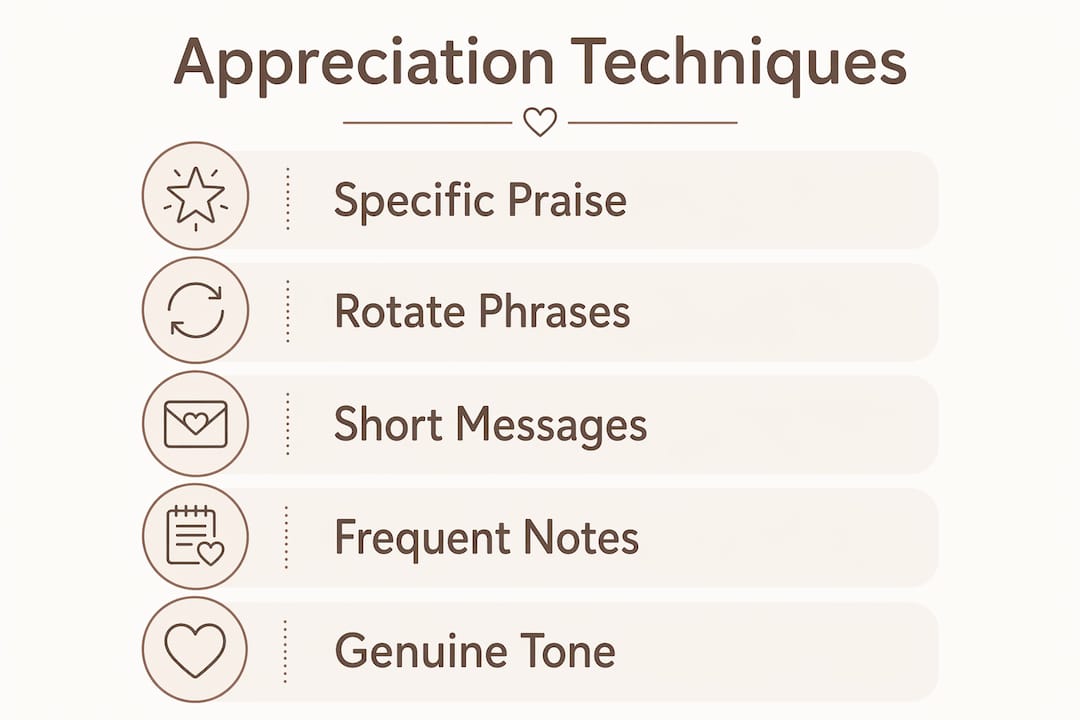
Specificity is the most important variable in verbal appreciation. Generic praise like “you’re amazing” lands softly and fades quickly. Naming exact behaviors or qualities, such as “I noticed you stayed calm when I was stressed this morning, and that helped me reset,” gives your partner something concrete to hold onto. The Gottman Institute emphasizes that specific spoken appreciations help a partner feel truly seen, not just complimented.
Effective couples appreciation techniques include:
- Thank your partner for routine acts. Recognizing chores, errands, and daily contributions counters the feeling of being taken for granted. Saying “thank you for handling dinner tonight” acknowledges effort that often goes invisible.
- Name a trait, not just an action. “You are so patient with your family” connects behavior to character and feels more meaningful than “thanks for being nice.”
- Acknowledge emotional support. When your partner listens during a hard moment, say so directly. “You really showed up for me today” is specific and emotionally resonant.
- Scan for positives daily. Actively looking for what your partner does well trains your attention away from irritants and toward appreciation. This is a deliberate habit, not a feeling you wait for.
- Avoid saving appreciation for conflict resolution. Expressing appreciation only post-conflict or on special occasions undermines its benefit. Daily proactive deposits prevent resentment from building.
Pro Tip: Rotate your appreciation phrases. If you say “I appreciate you” every day in the same tone, it becomes background noise. Change the phrasing, the timing, and the specific detail you name to keep it genuine.
Couples who practice short, specific messages of appreciation throughout the day report stronger emotional connection than those who rely on grand gestures. Frequency and specificity together do more than any single romantic event.
How do differences in verbal expression affect couples?
Not every partner is naturally verbal. One person may express love through acts of service while the other thrives on spoken affirmation. This mismatch is common, and it does not have to create distance.
The Oregon State University research is clear: relative expression levels matter less than the total amount of affectionate communication in the relationship. Even if one partner verbalizes less naturally, elevating the overall level of affectionate communication benefits both people. The less expressive partner does not need to match the other. They need to contribute meaningfully.
Practical steps for couples navigating different expression habits:
- Do not wait for reciprocity. If you are the more verbal partner, keep expressing appreciation without scorekeeping. The research shows your expressions benefit both of you.
- Ask your partner what lands best. Some partners feel more appreciated by specific compliments; others respond to acknowledgment of their effort. Ask directly rather than guessing.
- Address feelings of underappreciation directly. If you feel unseen, name it without blame. “I feel most connected when you tell me what you value about me” is a request, not an accusation.
- Create low-pressure moments for expression. A quiet evening walk or a morning coffee ritual gives a less verbal partner a natural context to speak appreciation without pressure.
Gender also plays a role. A Swiss couple study found that perceived partner gratitude mediates relationship satisfaction, with women tending to value receiving gratitude expressions more distinctly. Awareness of this difference helps couples tailor their approach rather than assuming their partner experiences appreciation the same way they do.
Pro Tip: If your partner struggles to verbalize appreciation, try modeling it without expectation. People often mirror what they receive consistently over time.
Verbal appreciation vs. other forms of affection: what works best?
Verbal appreciation belongs to a broader framework of relational communication. Gary Chapman’s five love languages include words of affirmation, physical touch, acts of service, quality time, and receiving gifts. Words of affirmation, the love language most aligned with verbal appreciation, focuses on verbal expressions of love and respect that nurture emotional intimacy and boost a partner’s self-esteem.
Verbal appreciation does not replace other forms of affection. It amplifies them. A partner who receives a thoughtful act of service feels it more deeply when it is also named out loud. “I saw you cleared my schedule for tomorrow so I could rest. That means everything to me” combines action with words and doubles the emotional impact.
| Form of affection | Primary benefit | Limitation without verbal pairing |
|---|---|---|
| Words of affirmation | Builds emotional intimacy and self-esteem | None when practiced with specificity |
| Acts of service | Demonstrates care through action | Can go unnoticed or feel transactional |
| Physical touch | Reinforces closeness and safety | Lacks explicit emotional meaning alone |
| Quality time | Deepens shared experience | Connection may feel assumed, not stated |
| Receiving gifts | Signals thoughtfulness | Meaning depends on context and words |
Verbal appreciation has a unique advantage: it is always available. Physical touch requires proximity. Acts of service require time and energy. A spoken or written word of appreciation costs nothing and can be delivered in seconds. That accessibility makes it the most consistent tool for building emotional connection across the full arc of a relationship.
Key Takeaways
Verbal appreciation is the most consistent and accessible tool couples have for building emotional intimacy, trust, and lasting relationship satisfaction.
| Point | Details |
|---|---|
| Specificity drives impact | Name exact behaviors or traits rather than offering generic praise to make your partner feel truly seen. |
| Frequency matters more than grand gestures | Daily small appreciations build a positive interaction ratio that sustains attraction and trust over time. |
| One expressive partner lifts both | Oregon State research shows total affectionate communication predicts satisfaction, not matched expression levels. |
| Gender shapes how gratitude lands | Women tend to value perceived gratitude more distinctly, so tailoring your approach improves mutual satisfaction. |
| Consistency prevents contempt | Reserving appreciation for conflicts or holidays allows resentment to build. Daily habits protect the relationship. |
Why I think most couples underestimate the power of daily words
Most couples treat verbal appreciation like a special occasion dish. They bring it out after a fight, on anniversaries, or when they want something. That pattern is exactly backward. The Gottman Institute’s research on daily proactive appreciation shows that waiting for conflict to express gratitude trains your partner to associate your warmth with tension, not with safety.
What I have observed, both in reading the research and in watching couples navigate long-term relationships, is that the couples who stay genuinely close are not the ones who have the most dramatic romantic gestures. They are the ones who have built a quiet, consistent habit of noticing each other. They say “I love how you handled that” on a Tuesday. They text “thinking of you” at 2 p.m. for no reason. They treat thoughtful digital communication as a normal part of their day, not a performance.
The common mistake is waiting to feel appreciative before speaking. Appreciation expressed consistently actually generates the feeling over time. Saying it first is not fake. It is how the habit forms. Couples who build this practice report that it changes how they see each other, not just how they talk to each other.
Start small. Pick one specific thing your partner did today and name it out loud before the day ends. That single sentence, repeated daily, does more for your relationship than most weekend retreats.
— Alan
Pingher makes daily appreciation effortless
Knowing what to say is one thing. Remembering to say it when life gets busy is another. Pingher is a messaging app built specifically for couples who want to express love and appreciation daily without letting it slip through the cracks.
With one tap, you can send a personalized message that tells your partner exactly what you value about them, right when it matters. Pingher combines the convenience of a quick message with the personal touch of something thoughtfully crafted. Couples who use it report feeling more consistently valued and emotionally connected. If you want to make verbal appreciation a real daily habit, try Pingher and see how much a few well-chosen words can shift your relationship.
FAQ
What is the role of verbal appreciation in couples?
Verbal appreciation in couples is the practice of expressing specific, positive recognition for a partner’s actions and qualities to build emotional intimacy and trust. The Gottman Institute identifies it as a core mechanism for countering contempt and sustaining fondness in long-term relationships.
How often should couples express verbal appreciation?
Daily expression is more effective than occasional grand gestures. The Gottman Institute’s research shows that a high ratio of positive to negative interactions, maintained through small daily appreciations, predicts relationship health over time.
Does verbal appreciation help if only one partner does it?
Yes. Oregon State University research on 141 couples found that total affectionate communication predicts relationship satisfaction more strongly than whether both partners express affection equally. One expressive partner benefits both people.
How does verbal appreciation differ from words of affirmation?
Words of affirmation is a love language category that includes verbal appreciation, but verbal appreciation is more specific. It focuses on naming exact behaviors, traits, or acts of support rather than general expressions of love.
Why does specificity matter in verbal appreciation?
Specific appreciations make a partner feel genuinely seen rather than generically praised. Naming an exact behavior or quality, such as “I noticed how patient you were in that conversation,” creates a deeper emotional impact than broad statements like “you’re great.”
Recommended
Built for couples who care.
Pingher helps you send the right words at the right moment.
Get Pingher on Google Play