The Role of Words of Affirmation in Relationships

The Role of Words of Affirmation in Relationships
Words of affirmation are spoken or written expressions that communicate appreciation, love, and respect, and they function as direct emotional catalysts in relationships and self-perception. The role of words of affirmation goes far beyond simple compliments. Research shows that consistent affirming language builds emotional safety, strengthens intimacy, and measurably improves self-esteem over time. Psychologist Gary Chapman first formalized this concept as one of the five love languages, giving couples a shared vocabulary for understanding how verbal validation meets a core emotional need. Whether you say “I’m proud of you” or text a quick “thinking of you today,” those words carry real psychological weight.
What does research say about the psychological effects of positive affirmations?
Self-affirmation interventions produce small to moderate psychological benefits, with effect sizes ranging from d = 0.14 to 0.48 across approximately 50 studies. That range means affirmations reliably move the needle, even if they are not a dramatic overnight shift. The strongest gains appear in sports performance and health behavior change, where affirming self-talk reduces avoidance and builds follow-through.
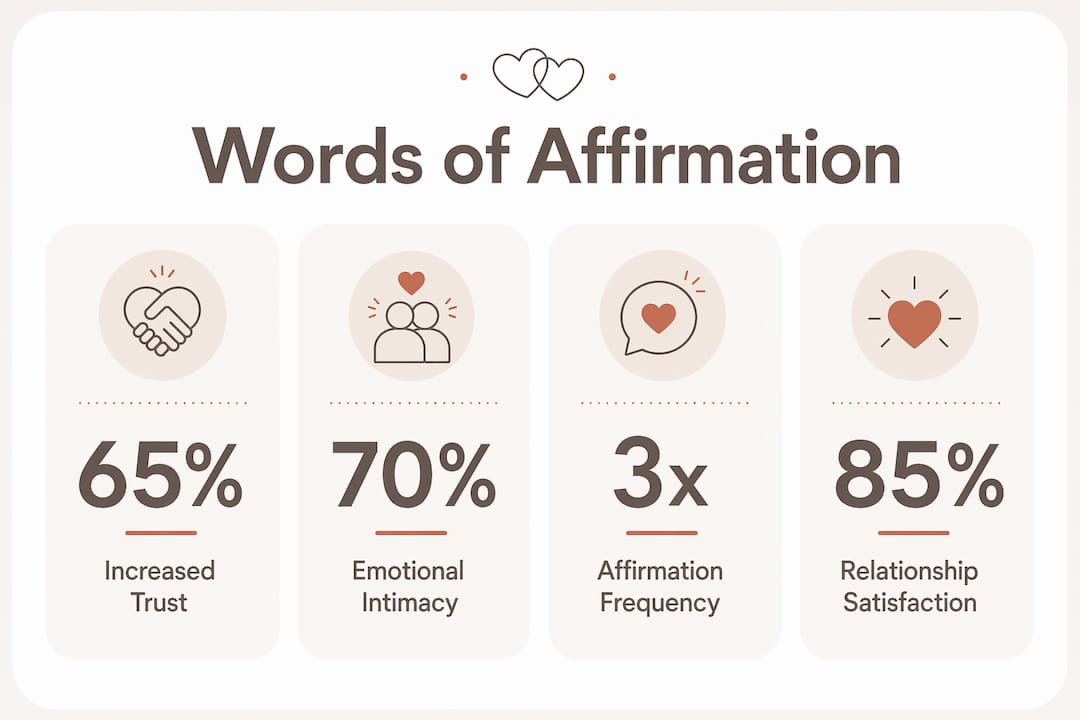
Frequency matters as much as content. A meta-analysis of 89 studies found that repeating affirmations at least three times daily for a minimum of one month produces sustainable reductions in stress and anxiety. That finding reframes affirmations as a practice, not a one-time event. Think of it the way you think about physical exercise: one session does not build strength, but a month of consistent effort does.
Writing personal positive affirmations twice daily over 15 days improves self-esteem in adults showing symptoms of non-diagnosed depression. That is a short intervention with a measurable outcome. The mechanism is gradual. Affirmations work by slowly shifting internal dialogue, replacing automatic negative thoughts with more balanced, realistic ones.
Here is what effective affirmation practice looks like in practice:
- Specific over generic. “You handled that difficult conversation with real patience” lands harder than “You’re great.”
- Present tense. Framing affirmations in the present (“I am capable”) activates the belief more directly than future framing.
- Emotionally resonant. The words must connect to something the person actually values about themselves or the relationship.
- Consistent delivery. Daily or near-daily practice outperforms occasional bursts of praise.
Pro Tip: If affirmations feel awkward at first, that discomfort is a signal you are stepping into vulnerability, not a sign the practice is wrong. Push through the first two weeks.
How do words of affirmation influence relationship dynamics and emotional intimacy?
Affirming language creates feelings of being seen and valued, and those feelings are foundational to emotional intimacy. When your partner tells you specifically what they admire about you, something shifts. You stop wondering if you are enough. That certainty is what deepens trust over time.

The vulnerability runs both ways. Saying “I love how you show up for me when I’m struggling” requires the speaker to admit they notice, they care, and they are willing to be open about it. The listener receives not just a compliment but evidence of being truly known. That mutual exposure is what separates surface-level praise from genuine connection.
Words of affirmation also serve a repair function in relationships. After a conflict, a well-timed, sincere acknowledgment, such as “I see how much that hurt you, and I’m sorry,” can rebuild emotional safety faster than almost any other gesture. Research on repairing emotional conflicts shows that affirming language helps rebuild identity and calm, particularly in children, but the principle applies across all close relationships.
“The essence of connection through words of affirmation is the vulnerability of expressing love and the recipient feeling deeply seen.” This is not about flattery. It is about witnessing another person honestly and telling them what you see.
Practical examples of affirming language in relationships include:
- Leaving a note that names one specific thing you appreciate about your partner that week.
- Sending a mid-day text that references something personal, not just “miss you” but “I keep thinking about how you made me laugh this morning.”
- Verbally acknowledging effort, not just outcomes. “I noticed how hard you worked on that” matters more than “good job.”
- Using affirmations as a daily check-in ritual, even 30 seconds before bed.
Micro-affirmations like sticky notes, brief texts, and public acknowledgments build what relationship researchers call the emotional bank account. Small, consistent deposits create a reserve of goodwill that makes conflict easier to navigate and connection easier to maintain.
What are common misconceptions and pitfalls when using words of affirmation?
The biggest misconception about affirmations is that they work like a light switch. Say the right words, feel better immediately. That is not how it works. Affirmations are cumulative, layered practices that shift internal dialogue gradually. Expecting instant results leads to abandoning the practice before it has time to take hold.
Toxic positivity is a real risk. When affirmations ignore genuine distress or paper over real problems, they can backfire. Research confirms that forced positivity is especially harmful for people with low self-esteem, because the gap between the affirming statement and their felt reality feels dishonest. The words ring hollow, and trust erodes.
Common pitfalls to avoid:
- Generic praise. “You’re amazing” without context feels performative. Name the specific behavior or quality you are acknowledging.
- Affirmations without action. Telling your partner you value them while consistently canceling plans sends a contradictory message. Words must align with behavior.
- Timing errors. Offering an affirmation in the middle of an argument, before the other person feels heard, can feel dismissive rather than supportive.
- Ignoring the recipient’s comfort level. Some people feel uncomfortable receiving direct praise. Start smaller and build up.
Pro Tip: Pair every affirmation with a matching action at least once a week. Words that are backed by behavior become credible. Words alone, repeated without follow-through, become noise.
Cultivating emotional honesty alongside affirmations prevents the toxic positivity trap and builds genuine resilience. Saying “this is hard, and I still believe in us” is more powerful than pretending everything is fine.
How can couples incorporate words of affirmation into daily life?
Consistency is the single most important factor in making verbal affirmation work. A grand declaration once a month does less for a relationship than a brief, genuine acknowledgment every day. The goal is to make affirming language a natural part of how you communicate, not a special occasion behavior.
Start with specificity. Vague compliments fade quickly. Specific ones stick. Instead of “you’re so supportive,” try “the way you listened to me vent about work yesterday without trying to fix it meant a lot.” That level of detail tells your partner you were paying attention, which is itself an act of love.
Practical strategies for building a daily affirmation habit:
- Use written formats. Written affirmations give the recipient something to return to. A text or note can be reread on a hard day in a way that a spoken word cannot.
- Build micro-moments. A 10-second verbal acknowledgment during a routine moment, like making coffee together, costs nothing and compounds over time.
- Practice self-affirmation too. Affirming yourself is not selfish. People who maintain a positive internal dialogue are better equipped to offer genuine affirmation to others.
- Set a low bar to start. One specific affirmation per day is enough. Perfection is not the goal. Presence is.
The table below shows how different affirmation formats compare in terms of effort and emotional impact:
| Format | Effort level | Emotional impact |
|---|---|---|
| Spoken compliment | Low | High when specific |
| Handwritten note | Medium | Very high, lasting |
| Text message | Very low | Moderate to high |
| Public acknowledgment | Medium | High, builds pride |
| Daily check-in ritual | Low | High over time |
Overcoming the initial awkwardness is the hardest part. Affirmations feel cringey at first for most people because they require stepping outside habitual communication patterns. That discomfort fades with repetition. After two to three weeks of consistent practice, affirming language starts to feel natural rather than forced.
For couples who want to build this habit but struggle with knowing what to say, thoughtful message ideas can provide a starting point without making the practice feel scripted.
Key takeaways
Words of affirmation work through consistency, specificity, and emotional honesty, not through volume or grand gestures.
| Point | Details |
|---|---|
| Consistency beats intensity | Daily brief affirmations outperform occasional grand declarations in building emotional connection. |
| Specificity is the difference | Naming exact behaviors or qualities makes affirmations feel genuine rather than performative. |
| Affirmations need action | Words must be backed by matching behavior to remain credible and build trust over time. |
| Toxic positivity is a real risk | Ignoring genuine distress while offering praise can backfire, especially for people with low self-esteem. |
| Micro-affirmations compound | Small consistent gestures like texts and notes build the emotional reserve that sustains relationships. |
What I’ve learned from watching affirmations actually work
I used to be skeptical of affirmations. They sounded like something you’d read on a motivational poster in a dentist’s waiting room. Then I started paying attention to what actually happened in relationships where people used them consistently, and my view changed completely.
The couples who do this well are not the ones saying the most poetic things. They are the ones who notice specific details and say them out loud. “I saw how tired you were, and you still showed up for me.” That kind of sentence does something a generic “I love you” cannot. It proves the speaker is paying attention.
The hardest part is not finding the words. It is tolerating the vulnerability of saying them. Expressing genuine appreciation out loud feels exposed in a way that most people underestimate. The discomfort is real, and it is also exactly why it works. Saying something true and tender to another person requires trust. That act of trust, repeated over time, is what builds intimacy.
My honest advice: do not wait until you feel comfortable. Start small, stay specific, and give it at least a month before you judge whether it is working. The shift is gradual, but it is real.
— Alan
Pingher and the habit of meaningful connection
Building a daily affirmation habit is simple in theory and genuinely hard in practice. Life moves fast, and thoughtful words get crowded out by schedules and distractions.
Pingher is built for exactly this problem. With one tap, you can craft and send a personalized message to your partner that feels considered, not rushed. Pingher provides message ideas tailored to real relationship moments, so you never stare at a blank screen wondering what to say. The daily reminder feature keeps the habit alive even on busy days. For couples who want the benefits of consistent verbal affirmation without the friction of figuring it out from scratch, Pingher makes the practice sustainable.
FAQ
What are words of affirmation in a relationship?
Words of affirmation are verbal or written expressions of appreciation, love, and respect directed at a partner. They create feelings of being seen and valued, which deepens emotional intimacy over time.
How often should you use words of affirmation?
Research recommends affirming language at least daily, with studies supporting three or more instances per day for measurable reductions in stress and anxiety over a sustained period.
Can words of affirmation backfire?
Yes. Generic or forced affirmations that ignore real emotional distress can feel hollow and erode trust, particularly in people with low self-esteem. Specificity and emotional honesty are what make them effective.
What are some simple words of affirmation examples for couples?
Effective examples include “I noticed how patient you were today,” “I’m grateful you’re my partner,” and “The way you handled that showed real strength.” Specificity is what separates these from empty praise.
Do words of affirmation improve self-esteem?
Writing personal positive affirmations twice daily over 15 days improves self-esteem in adults with mild depressive symptoms. The effect is gradual and cumulative, not immediate.
Recommended
Built for couples who care.
Pingher helps you send the right words at the right moment.
Get Pingher on Google Play