The Best Relationship Bonding Tools for Couples in 2026

The Best Relationship Bonding Tools for Couples in 2026
For most busy couples, the most effective relationship bonding tools in 2026 are AI-personalized micro-message and reminder apps, with Pingher standing out as a practical fit. Pick one tool today and commit to the 4-week starter plan below.
Key Takeaways
The most effective relationship bonding approach in 2026 combines consistent daily micro-rituals grounded in Gottman research with one weekly novelty session and a low-friction reminder tool.
| Point | Details |
|---|---|
| Daily rituals beat grand gestures | Gottman research links small, consistent turning-toward behaviors to stronger relationship stability than occasional big efforts. |
| The 5:1 ratio is your benchmark | Aim for roughly five positive interactions for every one negative to keep the emotional balance healthy. |
| Weekly novelty matters too | UC Berkeley research supports adding one 90-minute novel activity per week to sustain positive emotional associations. |
| Choose tools with bilateral controls | Both partners must engage; prioritize apps with independent privacy settings, evidence-based prompts, and easy onboarding. |
| Pingher for daily micro-messages | Pingher’s one-tap messaging, AI templates, and scheduled reminders make consistent daily affection practical for busy couples. |
Table of Contents
- Why daily micro-rituals are the top relationship bonding tools in 2026
- What are the top tool categories for relationship bonding?
- How do you choose the right bonding tool for your relationship?
- A 4-week starter plan that integrates bonding tools into daily life
- When does a bonding tool help, and when should you seek professional support?
- Why Pingher fits the 2026 brief for busy couples
- An editorial perspective on what actually moves the needle
- Pingher makes daily connection effortless for busy couples
- Sources
Why daily micro-rituals are the top relationship bonding tools in 2026
Grand gestures get the credit, but small daily behaviors do the actual work. The Gottman Institute’s research shows that consistent “turning toward” behaviors and ritualized connection predict relationship stability far more reliably than occasional big moments. The mechanism is straightforward: every small positive response to a partner’s bid for connection builds emotional trust over time.
The number that anchors this is the 5:1 magic ratio. Gottman’s research links roughly five positive interactions for every one negative to measurably healthier relationships. That ratio is not about suppressing conflict; it’s about keeping the daily emotional bank account in surplus.
The 5:1 ratio: Gottman research finds that couples who maintain approximately five positive interactions for every one negative interaction show significantly stronger relationship stability over time. Source
Two other research streams reinforce this. The UC Berkeley Greater Good Science Center finds that shared novel or exciting activities increase relationship satisfaction by creating positive emotional associations. Separately, the University of Florida SMART Couples program recommends simple daily acts, such as gratitude notes and short check-ins, and structures them into a 30-day challenge format.
Where AI-personalized tools fit in: apps that send scheduled reminders and personalized prompts act as digital scaffolding for turning-toward behaviors. When life gets busy, the cue disappears. A well-timed prompt brings it back without requiring willpower.
Key evidence at a glance:
- Gottman’s Sound Relationship House and 12 exercises ground daily rituals in decades of couples research
- UC Berkeley recommends weekly novelty sessions to sustain positive emotional associations
- SMART Couples’ 30-day challenge proves short daily acts build durable habits
- AI-personalized reminders reduce the friction that causes consistent rituals to lapse
What are the top tool categories for relationship bonding?
Not every couple needs the same tool. The right category depends on where the friction actually lives in your relationship. Here are the seven most useful types, with a note on what each does best.
-
AI-personalized micro-message and reminder apps (Pingher-style): Schedule and send warm, personalized messages without needing to think of the right words every day. Best for busy couples who want consistent emotional presence. Look for AI-assisted templates, scheduling controls, and bilateral notification settings.
-
Daily-question and prompt apps (Gottman-style card decks): Structured questions that deepen Love Maps and Fondness & Admiration. Best for couples who want guided conversation starters. Prioritize evidence-based question banks and customizable difficulty levels.
-
Shared calendars and household coordinators: Reduce logistical friction, which is a real source of resentment. Best for couples managing complex schedules. Look for color-coded views, shared task lists, and notification syncing.
-
Shared-finance helpers: Transparency around money reduces a common conflict trigger. Best for couples combining finances or splitting expenses. Prioritize clear permission settings and data-sharing controls.
-
Date-planning and micro-date generators: Remove the “what do you want to do?” stalemate. Best for couples whose date nights have gone stale. Look for location-aware suggestions and budget filters.
-
Experience and novelty challenge tools: Structured lists of new activities to try together, grounded in the UC Berkeley exciting-activities research. Best for couples in a comfortable but low-stimulation routine.
-
Low-friction intimacy builders (one-tap affectionate gestures): A single tap sends a “thinking of you” signal. Best for long-distance couples or partners with mismatched schedules. Look for read receipts and reaction options.
Pro Tip: Consumer research suggests keeping your total app stack to three or fewer. One household coordinator, one connection app, and one finance tool (only if needed) covers most couples without creating app fatigue.
How do you choose the right bonding tool for your relationship?
Start with three non-negotiables: both partners need to use it, it needs to be easy enough to open daily, and its prompts should be grounded in real research rather than generic positivity content.
Quick scorecard (rate each 1–3):
- Usability: Can both of you set it up and use it in under five minutes? Score 3 if yes, 1 if it requires a tutorial.
- Evidence base: Does it draw on Gottman, SMART Couples, or comparable research? Score 3 for explicit sourcing, 1 for generic content.
- Privacy controls: Can you control data retention, sharing, and account access independently? Score 3 for granular controls, 1 for no visible settings.
- Cost: Does the pricing fit a 3-month trial without a long commitment? Score 3 for a free tier or monthly billing, 1 for annual-only.
A combined score of 10 or higher is a strong signal. Below 7, keep looking.
Privacy checklist before you commit:
- Confirm the app does not sell message content to third parties
- Check whether both partners can delete their data independently
- Verify that reminders and notifications can be silenced without the other partner being notified
- Review whether the app uses end-to-end encryption for stored messages
- Check account-deletion options before you create an account, not after
Communication tools that support long-term relationships consistently score highest when both partners feel ownership over the experience, which is why bilateral controls matter as much as features.
A 4-week starter plan that integrates bonding tools into daily life
Consistent 10–15 minute daily rituals plus one weekly novelty session produce meaningful day-to-day bonding within a month. Here is how to build that habit using the evidence above.
Week 1: Establish the morning and evening ritual
- Set up your chosen app and create five message templates: two gratitude notes, two check-in questions, one playful message.
- Schedule one morning message (send at 8 AM) and one evening check-in (send at 7 PM) every day.
- Use a Love Maps question each evening: “What’s one thing on your mind this week that I might not know about?”
- Track your 5:1 ratio informally: at day’s end, count positive exchanges versus tense ones.
Week 2: Add Fondness and Admiration
- Each morning message this week names one specific thing you admire about your partner. Example: “I noticed how patient you were with the kids last night. That’s one of the things I love most about you.”
- Add a SMART Couples-style gratitude note three times this week, sent as an unplanned midday message.
- Weekly novelty session: try one new activity together for 90 minutes, per the UC Berkeley recommendation. A cooking class, a new hiking trail, or a board game you’ve never played all qualify.
Week 3: Stress-Reducing Conversation
- Add a 10-minute “stress-reducing conversation” each evening, a Gottman exercise where each partner vents about outside stress (not the relationship) while the other listens without problem-solving.
- Use your app to schedule a reminder at 8 PM: “Time for our 10-minute check-in.”
- Measure: rate your mood before and after the conversation on a 1–5 scale. Most couples see a consistent lift by day 3.
Week 4: Measure and adjust
- Review your weekly mood ratings. If the average is below 3.5, add one more daily positive message.
- Check your 5:1 ratio. If it’s running closer to 3:1, increase scheduled gratitude messages before addressing any friction directly.
- Plan your next novelty session for the following week. Variety matters more than the specific activity.
- Daily time budget: 10–15 minutes total (5 minutes composing or reviewing messages, 10 minutes for the evening check-in)
- Weekly time budget: 90 minutes for the novelty session plus the daily total
When does a bonding tool help, and when should you seek professional support?
Bonding tools are built for prevention and maintenance. They work well when a relationship is fundamentally stable but needs more consistent attention. They are not a substitute for therapy when serious problems are present.
Seek a Gottman-trained therapist or licensed couples counselor if you recognize any of the following:
- Persistent contempt (eye-rolling, mockery, dismissiveness) that does not respond to positive efforts
- Active betrayal or a breach of trust that has not been addressed directly
- Emotional or physical abuse of any kind
- Untreated severe mental illness affecting daily functioning
- Repeated conflict cycles that leave both partners feeling worse, not better
If safety is an immediate concern, contact the National Domestic Violence Hotline at 1-800-799-7233. No app addresses these situations.
This article provides general relationship wellness information, not professional mental health or therapeutic advice. If you are experiencing serious relationship distress, please consult a licensed therapist.
Why Pingher fits the 2026 brief for busy couples
Pingher is built for the exact gap this research identifies: couples who know they should be more consistent with affection and appreciation but run out of time and mental bandwidth to act on it.
The core feature set maps directly to the evidence-based practices above:
- One-tap messaging: Send a warm, personalized message in seconds, no drafting required
- AI-assisted templates: Gratitude notes, check-in questions, and playful messages generated from your relationship context
- Scheduled reminders: Set morning and evening sends so the ritual happens even on busy days
- Important date tracking: Anniversaries, milestones, and recurring moments are flagged automatically
- Privacy controls: Message scheduling and account settings are independently managed
Quick-start routine for your first 7 days:
- Download Pingher and create your first five templates (two gratitude, two check-in, one playful)
- Schedule one morning and one evening message for the week
- Review the creative message examples to personalize your templates
- Set up date-tracking for your next anniversary or meaningful date
- Review privacy settings before inviting your partner
Pro Tip: Start with the gratitude template. Naming one specific thing you appreciate about your partner, rather than a generic “I love you,” activates the Fondness and Admiration dynamic Gottman identifies as a core relationship stabilizer.
Pingher offers a free tier and a Pingher+ subscription available monthly or annually through Google Play and Stripe.
An editorial perspective on what actually moves the needle
The tools in this article are genuinely useful. But the most common mistake couples make is treating an app download as the work itself.
The research from Gottman, UC Berkeley, and SMART Couples points to the same conclusion: consistency beats intensity. A two-minute gratitude message sent every morning for 30 days does more than a weekend retreat followed by silence. The reason AI-personalized reminder tools matter in 2026 is not that they are clever. It’s that they remove the single biggest obstacle to consistency, which is remembering to do it when life is loud.
Where I’d draw the line: if a couple is in active conflict or one partner is disengaged, no app closes that gap. The tool works when both people are willing. When one isn’t, the conversation that needs to happen is with a therapist, not a notification.
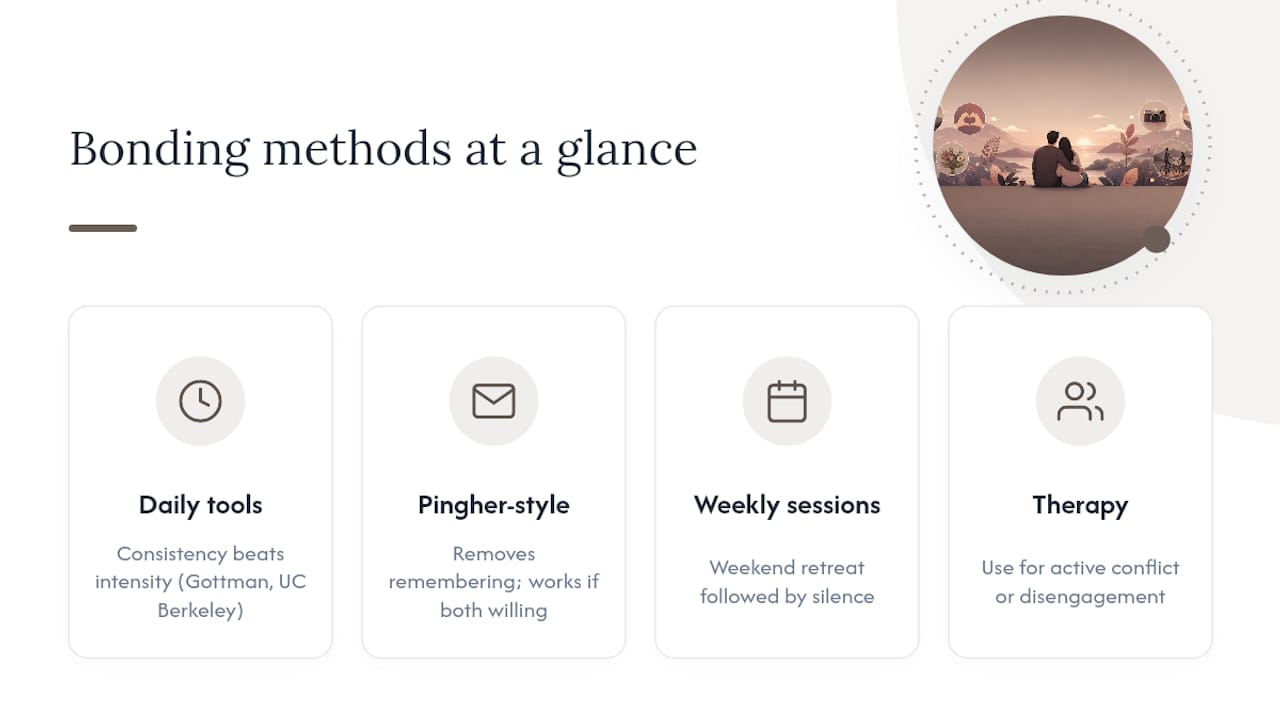
For couples who are basically solid but drifting, Pingher-style tools are the right starting point. For couples who want more structured conversation depth, pairing a micro-message app with a Gottman-based prompt deck covers both bases without overcomplicating the stack.

Pingher makes daily connection effortless for busy couples
Daily emotional connection doesn’t require long conversations or elaborate plans. It requires showing up consistently, and Pingher is built to make that frictionless.
With one-tap personalized messaging, AI-generated templates, and scheduled reminders, Pingher handles the cueing so you handle the connection. Set up five templates, schedule your first week of morning messages, and review your privacy settings in under 10 minutes. The free tier gets you started; Pingher+ unlocks scheduling, AI suggestions, and date tracking for couples who want the full daily ritual experience.
Download Pingher, create your first gratitude message today, and let the 4-week plan above do the rest.
Sources
- The Little Things That Keep Love Strong
- Exciting Activities for Couples | Practice | Greater Good in Action
- SMART Couples — Try this 30-day challenge
- 12 Gottman Exercises for Couples: A Practical Guide | TherapyExplained
Recommended
Built for couples who care.
Pingher helps you send the right words at the right moment.
Get Pingher on Google Play