Minimalist Romance Practices That Actually Fit Your Life

Minimalist Romance Practices That Actually Fit Your Life
The core types of minimalist romance practices are timed micro-rituals, micro-messages and one-tap appreciations, scheduled check-ins, brief physical touch moments, and low-lift dates. Each one takes between 10 seconds and 90 minutes, and you can start any of them today.
Here’s the short version:
- Timed micro-rituals (3–5 min): morning, midday, after-work, and bedtime connection moments
- Micro-messages / one-tap appreciations (30 sec): a text, voice memo, or photo sent mid-day
- Scheduled check-ins (10–20 min): weekly or daily emotional weather reports
- 10-second touch moments (10 sec): a hug, hand squeeze, or forehead kiss at transition points
- Low-lift dates (60–90 min): a walk, coffee run, or parking-lot takeout
| Practice | Best slot | Time needed |
|---|---|---|
| Morning micro-ritual | Before first coffee | 3 min |
| Midday micro-message | Lunch break | 30–60 sec |
| After-work reconnection | First 5 min home | 5 min |
| Bedtime appreciation | Lights out | 5 min |
Small, everyday acts of care — compliments, touch, small favors — consistently outperform occasional grand gestures for relationship satisfaction. That’s the whole premise here.
Key Takeaways
Minimalist romance practices work because they’re short enough to do every day and specific enough to feel real — not because they’re grand.
| Point | Details |
|---|---|
| Pick one ritual first | Start with the morning transition or bedtime appreciation — anchor it to an existing routine. |
| Use the three-part check-in | Share a positive, share a need, ask the catch-all — keeps weekly check-ins safe and focused. |
| Send three micro-messages | Choose three templates from this guide and save them for instant use during the workday. |
| Follow the 2-2-2 cadence | Two micro reconnects weekly, one low-lift date every two weeks, one pattern interrupt every two months. |
| Pingher automates the habit | Schedule daily reminders and one-tap appreciations so the practice runs even on your busiest days. |
Table of Contents
- What are the best types of minimalist romance practices for busy couples?
- Ready-to-send micro-messages you can use right now
- How do you make these practices automatic?
- What cadence should you follow daily, weekly, and monthly?
- What to do when minimalist romance practices stop working
- Why small beats grand every time
- Pingher makes the daily habit automatic
- Sources
What are the best types of minimalist romance practices for busy couples?
Five ritual templates cover the full day. Each one has a strict timebox to fit naturally into your schedule.
Morning transition (brief)
Before one of you leaves or opens a laptop, make eye contact and say one specific thing you’re looking forward to doing together, even if it’s weeks away. Then a 6-second kiss (not a peck) and a short phrase: “I’m glad we’re doing this life together.” That’s it. Five-minute connection rituals like this one give couples a daily structure that holds even on the worst mornings.

Midday bridge (1–2 minutes)
One text, voice memo, or photo. No reply required. The point is the signal, not the conversation. Examples: a photo of something that reminded you of them, a 20-second voice memo saying what you’re looking forward to tonight, or a single line like “Thinking about you between meetings.” Morning messages specifically reinforce the bond formed at the start of the day.
After-work reconnection (5 minutes)
This one has a rule: no logistics for the first five minutes. No “Did you call the plumber?” Ask one of these instead:
- “What was the best part of your day?”
- “What’s one thing you need from me tonight?”
- “What are you still thinking about?”
A structured daily check-in functions as an early-warning system, catching small resentments before they compound. Five minutes of real attention does that work.
Bedtime reconnection (5 minutes)
Phones face-down. Say one specific thing you appreciated about your partner today. Not “You’re great” — something concrete: “I noticed you handled that call without complaining, and it made me proud.” Then a 10-second hug before sleep.

10-second touch moments
Scatter these through the day at natural transition points:
- Hand on the shoulder when passing in the kitchen
- Forehead kiss before leaving a room
- Hand squeeze when sitting next to each other
- Brief back rub while they’re at their desk
| Ritual | Realistic slot | Time |
|---|---|---|
| Morning transition | Before first coffee | 3 min |
| Midday bridge | Lunch break or commute | 1–2 min |
| After-work reconnection | First 5 min home | 5 min |
| Bedtime appreciation | Lights out | 5 min |
| 10-second touch | Any transition point | 10 sec |
Pro Tip: Attach each ritual to something you already do — the coffee maker, the commute, brushing your teeth. Anchoring a new behavior to an existing one is how it becomes automatic without willpower.
Ready-to-send micro-messages you can use right now
Copy any of these. Save the ones you like. Send them without overthinking it.
Appreciation (workday)
- “You made this morning easier. Thank you.”
- “I keep thinking about how you handled [specific thing] yesterday.”
- “Grateful for you today.”
Encouragement (before a hard meeting or task)
- “You’ve got this. I’ll be thinking about you at 2.”
- “Go get it. I’m proud of you before it even happens.”
Thinking of you (commute or travel)
- “Saw something that made me think of you. Sending it later.”
- “Miss you already and it’s only been an hour.”
- “Counting down to tonight.”
Small celebration
- “That thing you did? It worked. You’re impressive.”
- “Can we celebrate this weekend? Even just dessert.”
One-tap appreciations (emoji + short phrase, under 30 characters):
- ❤️ “Thinking of you”
- 🙌 “Proud of you”
- ☕ “Wish we were here together”
Voice memo prompts (record under 30 seconds):
- “One thing I love about you that I don’t say enough…”
- “Here’s what I’m looking forward to when I see you…”
- “I noticed [specific thing] today and wanted you to know.”
Photo caption ideas: a coffee cup with “Wish you were here”, a sunset with “Saving this for you”, a screenshot of something funny with “This is so us.”
Expressing appreciation regularly, mixing routine thank-yous with surprise notes, predicts stronger relationship quality than either approach alone. The variety matters as much as the frequency.
How do you make these practices automatic?
Automaticity is the goal. Not motivation, not mood, not remembering. The practices that survive a busy month are the ones that run on autopilot.
The method: pair each practice with an existing anchor. Implementation intentions work like this: “When I pour my morning coffee, I will send one appreciation text.” That specific if-then format removes the decision entirely. The Gottman Institute’s guidance on small, frequent behaviors points to the same principle: “small things often” beats occasional effort every time.
14-day micro-plan
- Days 1–3: Set one phone alarm labeled “[Partner’s name] — 30 seconds.” Send one text when it fires.
- Days 4–7: Add the morning transition ritual. Anchor it to coffee.
- Days 8–10: Add the bedtime appreciation. Anchor it to phone-down time.
- Days 11–14: Add one midday voice memo or photo. No reply expected.
Track it with a single checkbox in your phone notes. Not a journal. Not a habit app. One checkbox per day. After 14 days, the external prompt matters less because the behavior has started to feel normal.
Affection reminders reduce friction at exactly the moment when motivation is lowest. Use calendar events or app-based reminders until the habit is self-sustaining, then decide whether to keep them or not.
Pro Tip: Imperfect execution is fine. Missing a day doesn’t break the habit — stopping for a week does. Consistency beats perfection every time.
What cadence should you follow daily, weekly, and monthly?
Daily is for micro-rituals. Weekly is for a focused check-in. Every two weeks is for a low-lift date. Every two months is for a pattern interrupt.
- Daily: one micro-ritual (morning or bedtime) plus one micro-message
- Weekly: a check-in using the three-part formula: share a positive, share a need, ask the catch-all question “Is there anything else you need from me this week?” This structure keeps check-ins safe and predictable.
- Every two weeks: a low-lift date — a walk, coffee, dessert run, or parking-lot takeout
- Every two months: a pattern interrupt — a new neighborhood, a day trip, anything that breaks the routine
The 2-2-2 rule captures this simply: two micro reconnects per week, one low-lift date every two weeks, one reset every two months.
| Cadence | Time commitment | Primary payoff |
|---|---|---|
| Daily micro-ritual | 3–5 min | Emotional continuity |
| Weekly check-in | 10–20 min | Awareness and triage |
| Bi-weekly low-lift date | 60–90 min | Novelty and shared experience |
| Two-month pattern interrupt | Half-day | Prevents routine fatigue |
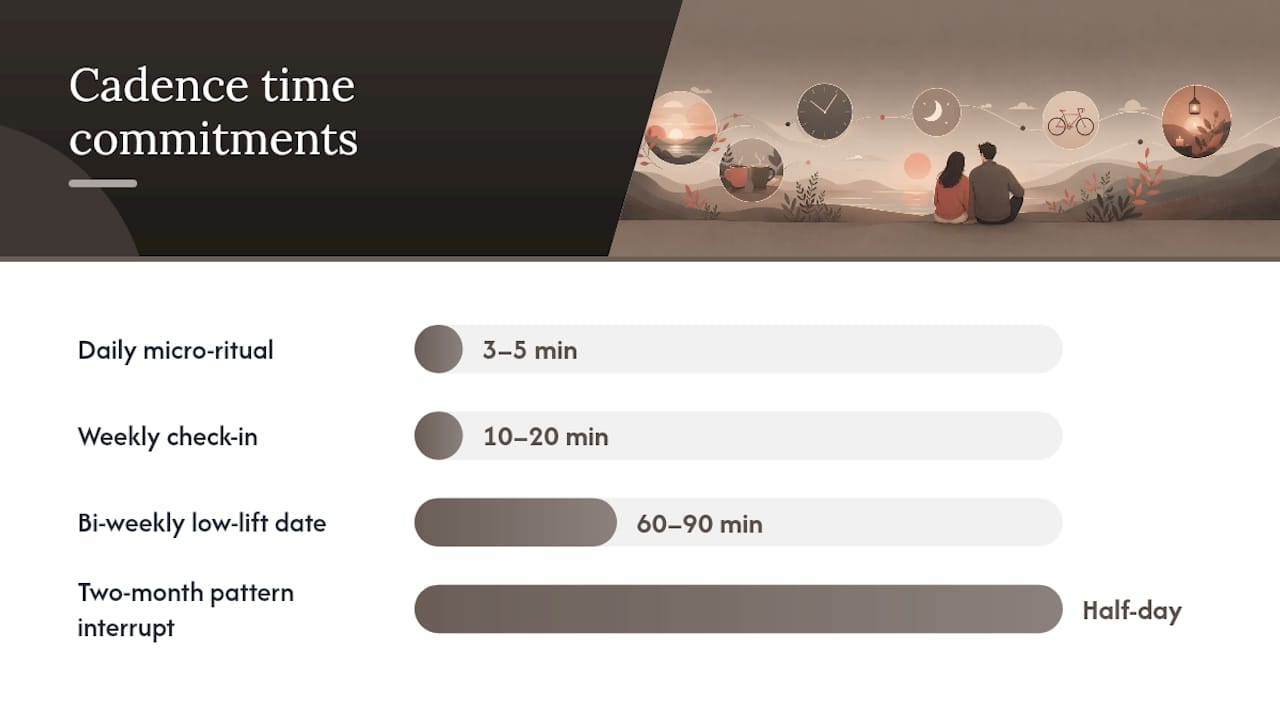
Qualitative research on long-term couples found that micro-gestures, gratitude, and quick repair sustain closeness across life transitions. The cadence above is designed to hit all three.
What to do when minimalist romance practices stop working
If rituals feel like chores: cut the timebox in half. A 90-second morning ritual beats skipping it entirely. Reduce the ask until it feels easy again, then rebuild.
If check-ins turn into complaint sessions: reapply the awareness-and-triage rule. Check-ins are for being seen and flagging issues, not solving them. If a problem needs solving, schedule a separate 20-minute conversation for it.
If one partner isn’t engaging: offer a trial week with no pressure to continue. Frame it as an experiment, not a commitment. Share one specific thing you got from it. Micro-commits work better than big asks.
Boundary rules that protect the practices:
- No logistics during check-ins (bills, schedules, chores belong elsewhere)
- No problem-solving unless it’s a scheduled conversation
- Phones face-down during reconnection moments
Pro Tip: If the same issue keeps surfacing in check-ins without resolution, that’s the signal to bring in a therapist or schedule a longer dedicated conversation. Check-ins surface problems; they don’t replace the deeper work.
Why small beats grand every time
Occasional grand gestures feel good in the moment, but they don’t build the daily trust that makes a relationship feel safe. Research on micro-affections shows that consistent small actions — a touch, a note, a specific compliment — create the emotional stability that couples actually rely on. Grand gestures are memorable. Small ones are load-bearing.
The practices in this guide are built around that finding. They’re short because short is what gets done. They’re repeatable because repetition is what builds trust. And they’re specific because vague intentions don’t survive a busy week. Showing love without grand gestures isn’t a compromise — it’s the more reliable path.
Pingher makes the daily habit automatic
Pingher is built for exactly this: the gap between knowing you should send a message and actually sending it when life is moving fast.
The app lets you write, schedule, and send personalized messages to your partner with one tap. Set a daily reminder, load three of your favorite templates from the micro-messages section above, and Pingher handles the timing. Core features that map directly to this guide:
- Scheduled sends: set a message to go at 12:30 PM every weekday without opening the app
- AI-suggested templates: get a starting line when you’re blank
- One-tap appreciations: save your go-to phrases and send them in a single tap
- Important date tracking: never miss an anniversary or milestone
- Daily reminder: one nudge per day to keep the habit alive
Quick start: set one daily reminder for your midday bridge, import three message templates, and run the 14-day plan. Start with Pingher and let the automation carry the habit while you focus on showing up.
Sources
- The Ultimate Daily Relationship Check-In Routine — Lindsay Walden
- 5-Minute Connection Rituals: Daily Intimacy for Busy Couples — DesireDecoder
- The little things in relationships that matter the most — Verywell Mind
- Everyday strategies to scale micro-affections: a qualitative study of couple practices — AFTJ
- 2-2-2 rule — This Love Works
Recommended
Built for couples who care.
Pingher helps you send the right words at the right moment.
Get Pingher on Google Play