What Does Heartfelt Communication Mean for Couples?

What Does Heartfelt Communication Mean for Couples?
Heartfelt communication means sharing your genuine thoughts and feelings with honesty, vulnerability, and full presence — not just exchanging words, but letting your partner actually see you. It’s the difference between saying “I’m fine” and saying “I’ve been feeling disconnected lately, and I miss you.”
- What it looks like in real messages: Specific, personal, and sent with intention — “I noticed you seemed tired today. I’m thinking of you” beats any generic “good morning” text.
- Its emotional function: It creates a felt sense of being known, which builds trust faster than any grand gesture.
- One thing to try right now: Before your next message, pause and ask yourself: Am I sending this from a place of care, or just habit?
Table of Contents
- What does heartfelt communication really mean in a relationship?
- Why sincere communication matters so much for couples
- What are the core components of heartfelt communication?
- What gets in the way, and how do you fix it?
- Daily practices and ready-to-send message examples
- How can an app help you stay consistent with heartfelt communication?
- Key Takeaways
- Why heartfelt communication is harder than it sounds
- Pingher makes the daily habit easy to keep
- Useful sources and further reading
What does heartfelt communication really mean in a relationship?
The word “heartfelt” traces back to Old English heorte, meaning heart, spirit, and mind. By definition, it describes something deeply or sincerely felt — not performed, not polished, just real.
In a romantic relationship, sincere communication works as a bridge of understanding between two people’s inner worlds. Your partner cannot read your mind. When you speak with genuine presence — choosing words you actually believe, using a tone that matches your feeling, letting yourself be a little exposed — you give them something to connect to. That’s the mechanism. It’s not about eloquence; it’s about contact.

A quick example: one partner texts, “I got frustrated earlier and I think it was actually about feeling unseen, not about the dishes.” That one sentence does more relational work than a week of smooth, conflict-free small talk. It invites the other person in rather than keeping them at arm’s length. For more on how thoughtful digital messages sustain that kind of contact over time, Pingher’s blog covers the research behind it.
Why sincere communication matters so much for couples
The benefits aren’t abstract. Couples who communicate with genuine emotional expression tend to repair conflict faster, feel more secure, and stay more resilient through hard seasons.
- Trust: When your partner knows you say what you mean, they stop second-guessing your silences.
- Intimacy: Sharing something real, even something small, closes emotional distance.
- Repair: Heartfelt exchanges can heal old wounds by inviting mutual vulnerability that becomes a cycle of trust.
- Resilience: Couples with a habit of genuine expression have a relational reserve to draw on when things get hard.
Dr. Michael Gerharz, who studies the clearest forms of human communication, argues that most people avoid this kind of talk because they mistake it for softness. His view is the opposite:
Mark Samuel of the Forbes Coaches Council frames it as an intention before a skill: heart-centered communication requires caring, kindness, and clarity working together. Miss one, and the message lands differently than you meant it to. A daily message habit — even one short text — keeps all three in practice.
What are the core components of heartfelt communication?
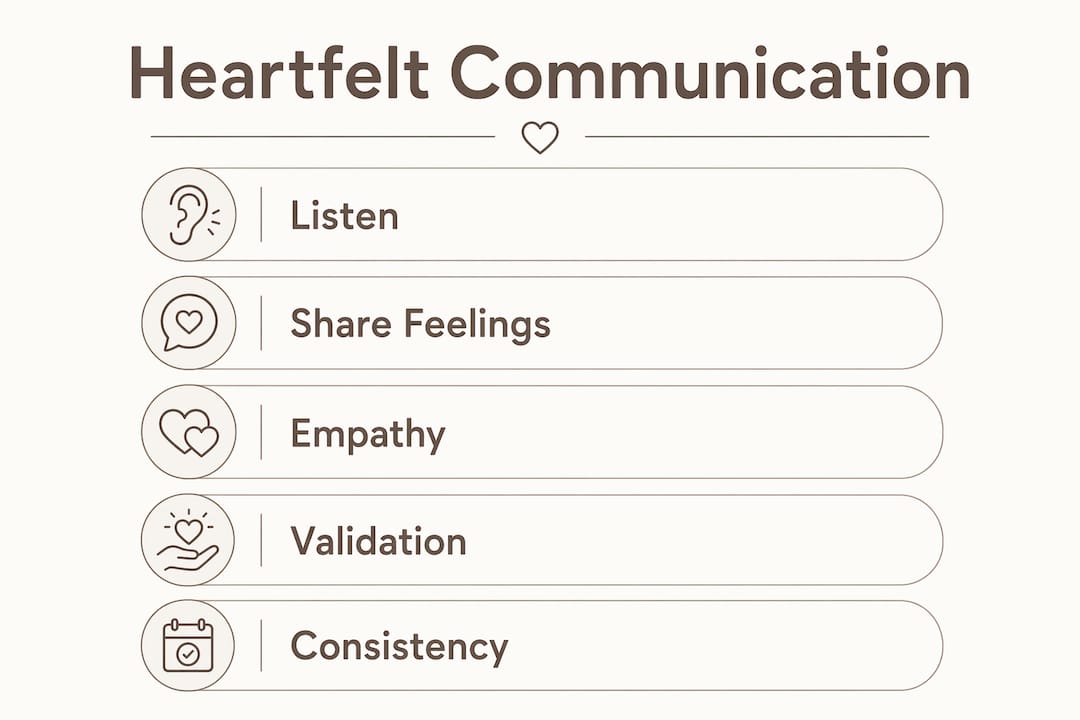
Five behaviors separate a heartfelt exchange from ordinary conversation:
| Component | What it looks like | What undermines it |
|---|---|---|
| Transparency of intent | “I’m saying this because I love you, not to win an argument.” | Hiding your real motive behind neutral language |
| Curiosity-based questions | “What did you need from me in that moment?” | Asking questions that are really accusations |
| Active listening | Full attention — no phone, no half-answers | Listening only to respond, not to understand |
| Vulnerability | Naming the feeling beneath the behavior | Staying safely vague (“I’m just stressed”) |
| Plain, brave words | “I miss you” instead of “Things have been off lately” | Flowery language that obscures the actual point |
Micro-practices (under one minute each):
- Transparency: Start one message today with “I’m telling you this because…”
- Curiosity: Replace one assumption with a question: “Am I reading that right?”
- Listening: Put your phone face-down for the first two minutes of a conversation.
- Vulnerability: Name the feeling, not just the event: “I felt proud of you” not “That was good.”
- Plain words: Cut the first sentence of your draft. The second one is usually more honest.
What gets in the way, and how do you fix it?
Most couples run into the same handful of barriers:
- Fear of seeming “too much”: Vulnerability feels risky. Fix: start small. One honest sentence is enough.
- Performative vulnerability: Sharing so much that your partner becomes an audience rather than a participant. Fix: filter the mess — share the detail that lets them relate, not the full unedited version.
- Sending from the wrong state: A message written in frustration reads as an attack even when the words are neutral. Fix: wait ten minutes, or send a placeholder (“I want to talk about something — can we connect tonight?”).
- Assuming the other person knows: Couples often skip the context because it feels obvious. Fix: say the thing you think goes without saying.
Pro Tip: Before you write a message that matters, run a one-sentence internal check: “Am I coming from caring, kindness, or calm right now?” If the answer is no to all three, wait. That single pause, recommended by Mark Samuel, changes how the message lands more than any word choice will.
Daily practices and ready-to-send message examples
Two short routines:
Short daily habit: Each morning, send one specific message — not “good morning” but something you actually noticed or felt. It requires only a brief moment of time.
10-minute weekly check-in: Once a week, ask your partner one open question about their inner world. Try: “What’s something you’ve been carrying this week that I might not know about?”
Message templates:
| Intent | Example message | Best time to send |
|---|---|---|
| Appreciation | “I noticed how hard you worked today. I see you.” | Evening |
| Repair | “I didn’t handle that well. Can we try again?” | After a conflict cools |
| Affection | “No reason — I just wanted you to know I’m glad you’re mine.” | Midday |
| Encouragement | “You’ve got this. And I’ve got you.” | Morning of a hard day |
| Curiosity | “What’s something you’ve been thinking about that we haven’t talked about?” | Weekend |
| Vulnerability | “I’ve been missing you even when we’re in the same room.” | Evening |
Quick dos and don’ts:
- Do: name a specific moment or detail — it proves you were paying attention.
- Do: send it when you mean it, not when you think you should.
- Don’t: open with “You always” or “You never” — it closes the door before you’ve said anything.
- Don’t: use a heartfelt message to reopen an unresolved argument.
For more ready-to-send message ideas, Pingher’s template library covers a wide range of tones and moments. You can also find guidance on sending affection messages during busy workdays specifically.
How can an app help you stay consistent with heartfelt communication?
The hardest part isn’t knowing what to say. It’s remembering to say it on a Tuesday at 2 PM when you’re in back-to-back meetings. That’s where a well-designed app earns its place.
Features that reliably support the habit:
- Scheduling: Write a thoughtful message when you have a clear head, send it at the right moment.
- Personalization prompts: A nudge that asks “What did your partner do this week that you appreciated?” beats a blank text field.
- Low-friction sending: One tap means you actually do it instead of drafting and abandoning.
- Contextual reminders: A reminder tied to a time your partner is usually free — not just a generic daily ping.
A couple where one partner travels for work might write three messages on Sunday night and schedule them for Monday through Wednesday mornings. The messages are still genuine; the timing is just handled. Another couple might use a reminder before their partner’s big presentation to send something specific and encouraging. The automation supports the habit without replacing the thought behind it.
One boundary worth keeping: if a message could have been sent to anyone, it probably shouldn’t be sent. Personalization is what makes the difference between a reminder and a real moment. For couples who want a complementary offline practice, guided journaling prompts can deepen the reflection that feeds better messages.
Key Takeaways
Heartfelt communication is a daily, intentional practice — not a grand gesture — and the couples who build it into small habits consistently report stronger trust, faster repair, and deeper intimacy.
| Point | Details |
|---|---|
| Clear definition | Heartfelt communication means sharing genuine thoughts and feelings with honesty, vulnerability, and full presence. |
| Core behaviors | Transparency of intent, curiosity-based questions, active listening, vulnerability, and plain words are the five key components. |
| Biggest barrier | Fear of seeming “too much” — start with one honest sentence and build from there. |
| Daily habit | A brief specific morning message beats any generic greeting for sustaining emotional connection. |
| Pingher’s role | Pingher helps busy couples schedule and personalize daily messages so the habit stays consistent without extra effort. |
Why heartfelt communication is harder than it sounds
Most relationship advice treats sincere communication as a soft skill — something you either have or you don’t. That framing gets it exactly wrong. Genuine expression requires you to know what you actually feel, find plain words for it, and send it before the moment passes. That’s three separate acts of courage compressed into one text message.
What I find most overlooked is the filtering problem. Couples often swing between two failure modes: saying nothing real, or saying everything at once and overwhelming their partner. The skill is in the middle — sharing the one detail that creates connection, not the full internal monologue. A message that says “I felt proud of you today” does more than a paragraph explaining why you’ve been feeling distant for three weeks. Precision is kindness.
The other thing worth saying plainly: communication tools support relationships that last not by replacing real conversation, but by keeping the habit alive on the days when real conversation isn’t possible. A scheduled message written with care is still a heartfelt message.
Pingher makes the daily habit easy to keep
Daily heartfelt messages work best when sending them doesn’t require a perfect moment or a clear schedule. Pingher is built for exactly that: one-tap sending, ready-made templates you can personalize, and scheduling that puts your message in front of your partner at the right time — not just whenever you remembered to send it.
Busy couples use Pingher to write a week’s worth of specific, personal messages in one sitting, then let the app handle the timing. The messages stay genuine because you wrote them; Pingher just makes sure they actually arrive. If you’ve been meaning to be more intentional about daily connection, start with Pingher and send your first heartfelt message today.
Useful sources and further reading
- Heartfelt Communication: Intimacy and Presence — yvex.de
- The Power of Heart-Centered Communication — Mark Samuel, Forbes Coaches Council
- The Hardest, Clearest, and Most Powerful Form of Communication — Dr. Michael Gerharz
- Effective and Heartfelt Communication — Root + River
- HEARTFELT Definition & Meaning — Dictionary.com
- Sincere Communication: Building Trust — Sparkmoor
- Meet Me Here — Tools for Meeting Each Other Well — relationship coaching and guided exercises for couples
For message inspiration, read Pingher’s guide to thoughtful message ideas for partners next.
Recommended
Built for couples who care.
Pingher helps you send the right words at the right moment.
Get Pingher on Google Play