What Is Micro-Connection in Relationships?

What Is Micro-Connection in Relationships?
Micro-connections are brief, intentional moments — a warm text, a held gaze, a sincere “I’m glad you’re here” — that signal emotional availability and safety to your partner. Rooted in Emotionally Focused Therapy (EFT) and supported by tools like Pingher, they take 30–60 seconds and reliably communicate that you are present, paying attention, and safe to turn to. That signal, repeated daily, is what keeps attachment secure between two people who are genuinely busy.
The research is clear: you do not need more time together. You need more moments of real contact inside the time you already share.
Table of Contents
- What is micro-connection in relationships, and why does it work?
- Why do couples lose micro-connections without noticing?
- Practical examples you can use today
- A 7-day starter plan for building the habit
- When micro-connections aren’t enough
- How digital tools can support your micro-connection habit
- Key Takeaways
- The case for small, consistent, and unglamorous
- Pingher makes the daily habit easier
- Useful sources and further reading
What is micro-connection in relationships, and why does it work?
A micro-connection is any small, genuine act that tells your partner: “I see you, I’m here.” EFT frames this through three questions a partner’s nervous system is always asking: Is my partner Accessible? Are they Responsive? Are they Emotionally Engaged? EFT clinicians call this the A.R.E. framework, and micro-connections are the everyday answer to all three.

The definition of micro-connections matters because it reframes what “working on your relationship” actually looks like. It is not a weekend retreat or a long conversation. It is a 20-second hug before you leave for work. It is a midday text that says nothing except “thinking of you.” Small, yes. Superficial, no.
Brief social exchanges across cross-cultural samples show measurable gains in life satisfaction. And Dr. David R. Hamilton describes micro-moments as biologically meaningful: they lower cortisol, increase vagal tone, and raise bonding-related neurochemicals even when the interaction lasts under a minute. The importance of micro-connections is not a soft claim. It is physiology.
Why do couples lose micro-connections without noticing?
The shift from relational to transactional communication is the most common culprit. When life gets busy, conversations shrink to logistics: who picks up the kids, what’s for dinner, did you call the plumber. Small bids for warmth are the first to disappear, and the decline is so gradual that couples often feel an unexplained drop in closeness before they can name what changed.
Several barriers compound this:
- Transactional talk. Every exchange becomes a task handoff. Warmth gets crowded out.
- Perfectionism. Waiting for the “right” moment to say something meaningful means saying nothing.
- The grand-gesture myth. Believing connection requires a date night or a vacation means daily moments feel too small to bother with.
- Busy schedules. Mornings are rushed, evenings are exhausted. There seems to be no window.
The mindset shift that actually helps: stop thinking of micro-connections as extra items on your to-do list. Think of them as an attentional overlay on routines you already have. You are already making coffee. You are already saying goodbye. You are already texting about dinner. The question is whether you add one warm, specific sentence to any of those moments. That is the entire practice.
Practical examples you can use today
Short in-person micro-actions take under a minute and produce real physiological calm. Concrete examples include a 20-second hug, sincere eye contact at a transition point (leaving, arriving, waking up), and a genuine “How are you, really?” check-in. Touch and eye contact activate the same oxytocin pathways as longer bonding behaviors.
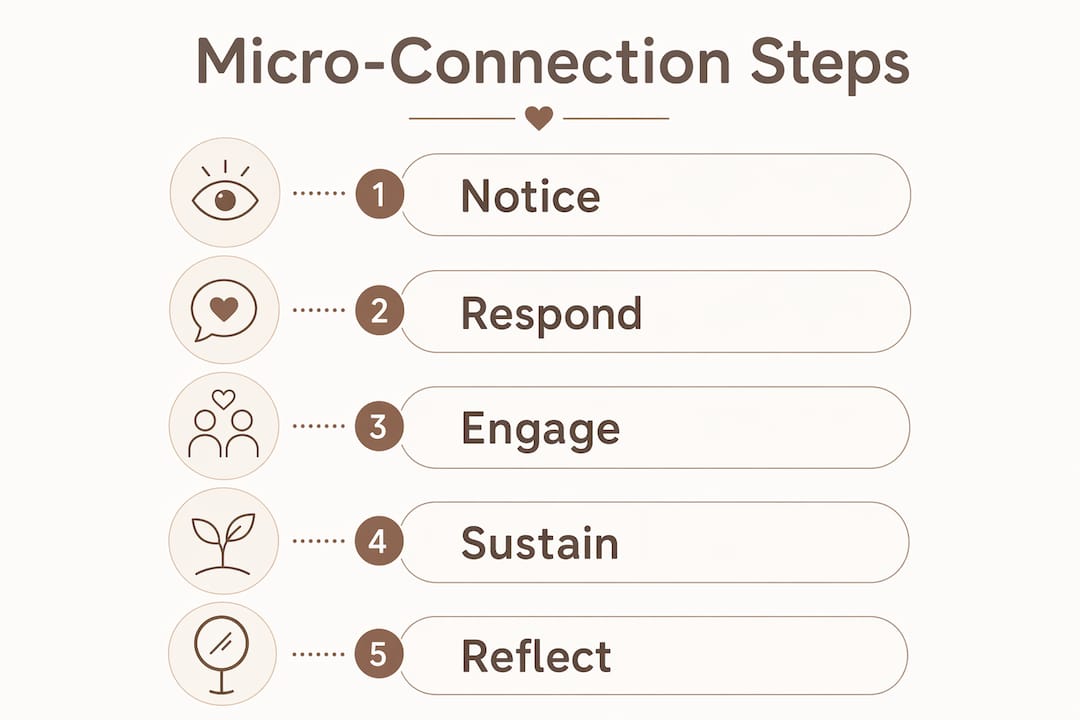
For digital micro-connections, specificity is everything. “I love you” sent every day becomes wallpaper. “I keep thinking about what you said at breakfast” lands differently. Here are ready-to-copy message templates organized by moment:
Morning:
- “Good morning. I hope today is kinder to you than yesterday.”
- “Thinking about you before the day takes over.”
- “You looked peaceful this morning. I didn’t want to wake you.”
Midday: 4. “How’s your day going? No need to reply — just wanted you to know I thought of you.” 5. “One thing I’m grateful for today: you.” 6. “Sending you a quiet ‘I’m rooting for you’ for whatever you’re dealing with right now.”
Evening: 7. “I’m glad we’re doing this life together.” 8. “What was the best part of your day? Tell me tonight.” 9. “You handled today well. I noticed.” 10. “I’m almost home. Can’t wait to just be near you.”
Anytime: 11. “I saw [something] today and immediately thought of you.” 12. “You don’t have to do anything. I just wanted you to feel seen.” 13. “I’m proud of you for [specific thing].” 14. “Remember when we [shared memory]? I love that we have that.” 15. “No agenda. Just: I love you and I like you.”
Pro Tip: Swap in one specific detail — a name, a memory, a thing they mentioned last week — and the message goes from warm to unforgettable. Generic scripts are a starting point; personalization is what makes them land. Pingher’s AI suggestions are built to prompt exactly that kind of specificity.
Building micro-connections into existing routines rather than adding new ones is what makes the habit stick. Piggyback on your morning alarm, your lunch break, or the moment you lock the front door.
A 7-day starter plan for building the habit
| Day | Action | Time | Busier-day option |
|---|---|---|---|
| Monday | Send a specific morning message (templates 1–3) | 30 sec | Emoji + one word |
| Tuesday | 20-second hug at departure or arrival | 20 sec | Squeeze hand at breakfast |
| Wednesday | Midday check-in text (templates 4–6) | 30 sec | Voice memo under 15 sec |
| Thursday | Eye contact + “How are you, really?” at dinner | 60 sec | Ask in a text instead |
| Friday | Evening appreciation message (templates 7–10) | 30 sec | Leave a sticky note |
| Saturday | Share a memory or inside reference (templates 13–14) | 30 sec | Send a photo with no caption |
| Sunday | Reflect together: what felt good this week? | 5 min | Text one thing you noticed |
A few adaptation notes:
- Shift workers or different schedules: Time the messages to when your partner wakes or takes a break, not when you feel like sending.
- Parents with young children: Morning drop-off and after-bedtime are natural micro-connection windows.
- Traveling partners: A scheduled good-morning message across time zones lands better than a spontaneous late-night call.
When micro-connections aren’t enough
Daily micro-moments sustain a healthy foundation. They cannot repair a cracked one alone. Watch for these signs:
- Your partner consistently does not respond to bids for connection, even small ones.
- Conversations escalate into conflict instead of landing in repair.
- Physical affection has dropped to near zero and neither of you initiates.
- One or both of you feels more like roommates than partners.
- Attempts at warmth feel forced or are met with withdrawal.
If several of these are true, micro-connections are still worth continuing, but they need backup. Longer, structured conversations about what each of you needs are the next step. After that, couples therapy with a clinician trained in EFT is the most evidence-supported route. The American Association for Marriage and Family Therapy (AAMFT) directory and the APA therapist locator are both good places to start. When mood symptoms like persistent low energy or anxiety are present for either partner, a medical review is worth adding to the list.
Bringing this up without blame sounds like: “I’ve been trying to reach for you more lately, and I want us to figure out together why it still feels distant.”
How digital tools can support your micro-connection habit
The right app does not replace genuine feeling. It removes the friction that stops you from expressing it. Features worth looking for:
- Scheduled delivery: Write the message when you have the thought; send it when your partner will actually receive it well.
- Templates and AI suggestions: Starting from a blank screen is the biggest barrier. A prompt that says “What specific thing did they do this week?” is more useful than a generic “say something nice.”
- One-tap send: The lower the effort, the more consistent the habit.
- Reminders tied to your routine: A nudge at 7:45 AM is more reliable than good intentions.
- Private delivery: Messages between partners should stay between partners.
Pingher is built around exactly this workflow. One couple used Pingher to schedule a curated morning note and a midday check-in every day for two weeks. By day five, the midday message had become something the receiving partner looked forward to enough to mention at dinner. That is the compounding effect micro-connections produce when they are consistent.
Pro Tip: Use Pingher’s personalized love tools to track recurring details about your partner — their current stressors, a running joke, a goal they mentioned — so your messages stay specific even on days when your brain is elsewhere.
Disclosure: This article is published by Pingher. The author, Alan, is affiliated with Pingher.
Key Takeaways
Micro-connections work because consistent, brief signals of availability, responsiveness, and emotional engagement build attachment security over time, and they require as little as 30–60 seconds per day.
| Point | Details |
|---|---|
| Definition | A micro-connection is a brief, genuine act that signals “I see you” to your partner. |
| Time investment | Each micro-connection takes just under a minute; the 7-day plan adds a small amount of time total per week. |
| EFT basis | EFT’s A.R.E. framework shows small moments answer the attachment questions partners ask constantly. |
| When to escalate | Persistent withdrawal, zero physical affection, or repeated unmet bids call for couples therapy. |
| Pingher | Pingher’s scheduling, templates, and one-tap send remove the friction that stops daily micro-connections. |
The case for small, consistent, and unglamorous
The conventional relationship advice cycle runs on big moments: the anniversary trip, the grand apology, the long talk that fixes everything. Those moments matter. But they are not what keeps two people feeling close on a Tuesday in February when nothing special is happening.
What actually holds a relationship together is the accumulation of small signals that say: you are still on my mind, I still choose you, I notice you. That is not a romantic idea. It is what emotional connection research consistently shows. The couples who feel most secure are not the ones who have the most dramatic love stories. They are the ones who show up in small ways, repeatedly, without waiting for the perfect moment.
The 7-day plan in this article is not a cure. It is a proof of concept. Try it for one week and notice what shifts. You will probably find that the hardest part is not the 30 seconds. It is giving yourself permission to believe that 30 seconds is enough.
Pingher makes the daily habit easier
Knowing what micro-connections are and actually sending them every day are two different problems. The first one this article solves. The second one is where Pingher comes in.
Pingher is a mobile app built for committed couples who want to stay emotionally close without adding another task to an already full day. Write a message when the thought strikes, schedule it to arrive at the right moment, or use AI-powered prompts to get specific when you are drawing a blank. One-tap send means the barrier between “I should reach out” and “I just did” is almost zero. Short messages with real impact are exactly what Pingher is designed to help you send, consistently, without it feeling like a chore.
Try the 7-day plan above using Pingher. Start here at pingher.app and see what a week of daily micro-connections actually feels like.
Disclosure: This article is written by Alan, affiliated with Pingher.
Useful sources and further reading
- How to Turn Everyday Moments Into Micro-Connections — Colorado Therapy Collective
- How Micro-Connections Shape Emotional Intimacy — Restoring Intimacy
- The “60-Second” Secret to Save Intimacy — Ubie Doctor’s Note
- Connection in Micro-Moments — Dr. David R. Hamilton PhD
- 3 Ways That Micro-Moments Secure a Relationship — Psychology Today
- Minimal Social Interactions and Life Satisfaction — GCN
- Find an EFT-trained couples therapist: AAMFT Therapist Locator or the APA Psychologist Locator
This article is general information, not professional relationship or mental health advice. For your specific situation, consult a licensed couples therapist or mental health professional.
Recommended
Built for couples who care.
Pingher helps you send the right words at the right moment.
Get Pingher on Google Play