Relationship Communication Health: Skills and Habits That Last

Relationship Communication Health: Skills and Habits That Last
Relationship communication health is the set of everyday practices that let partners understand, support, and repair their connection — not just when things are easy, but especially after conflict, stress, or distance. The clearest sign of it isn’t the absence of arguments. It’s what happens after: do you find your way back to each other?
Quick signs you already have it:
- You feel heard, not just tolerated, when you share something difficult
- Repair happens after conflict — an apology, a joke, a touch — and it lands
- Kindness is predictable, not reserved for special occasions
- You can make a clear request without it turning into a fight
- Emotional reactions get named, not weaponized
This guide covers the core skills, the patterns that quietly erode connection, step-by-step exercises with ready-to-use scripts, daily habits that make practice stick, and clear signals that it’s time to bring in a professional.
Table of Contents
- Why does communication quality predict relationship satisfaction?
- What does “communication” actually cover in a relationship?
- The core skills that create healthy relationship communication
- Common harmful communication patterns and how to interrupt them
- Step-by-step exercises to strengthen how you communicate
- Daily habits and tools that keep communication healthy over time
- How habit-focused messaging tools support relationship communication
- When should you seek professional help for relationship communication?
- Key Takeaways
- The part most communication advice gets wrong
- Pingher makes daily communication habits easier to keep
- Useful sources and further reading
Why does communication quality predict relationship satisfaction?
The short answer: because communication quality predicts relationship satisfaction over time, not just in the moment. Longitudinal research published in PMC found that for a given couple, worsened communication consistently predicted deteriorations in future relationship satisfaction — within the same couple, across time. That’s not a between-couples comparison. It means your own communication patterns, tracked over months, forecast where your relationship is headed.
The 5:1 ratio: Gottman Institute research shows that stable couples maintain roughly five positive interactions for every negative one. Below that ratio, conflict starts to feel like the default register of the relationship.
Poor communication doesn’t just create awkward silences. Chronic, low-level poor communication acts as a physiological stressor — it raises cortisol, disrupts sleep, and over time can harm physical health. Three consequences show up most reliably:
Emotional distance. When partners stop sharing the small things — frustrations, small wins, passing thoughts — intimacy quietly drains away. By the time it’s noticeable, months of micro-disconnections have already accumulated.
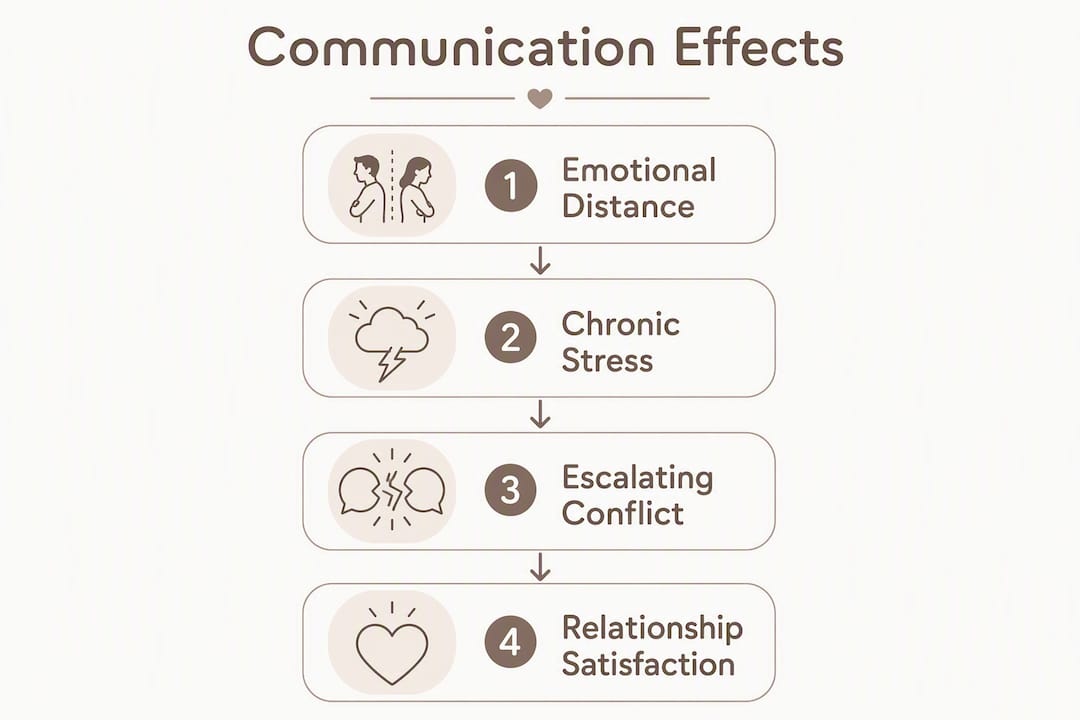
Chronic stress. Unresolved tension doesn’t disappear between conversations. It becomes background noise that colors everything else: work performance, mood, parenting, health.
Escalating conflict. Small grievances that never get addressed compound. What starts as a disagreement about dishes becomes a fight about respect. The original issue is almost never the real issue by then.
What does “communication” actually cover in a relationship?
Most people think of communication as the words they say. That’s roughly one-third of it.
Verbal content is what you say: the words, the topic, the request or complaint. Nonverbal signals are everything else: tone of voice, eye contact, posture, timing, touch. And listening — genuinely receiving what your partner is saying, not just waiting for your turn — is its own distinct skill that most people overestimate in themselves.
These three channels interact constantly. Consider two versions of the same sentence:
“I’m fine.” — said with eye contact, a relaxed posture, and a small smile. That’s probably fine.
“I’m fine.” — said while turning away, arms crossed, voice flat. That’s not fine, and both people know it.
Gottman-based research confirms that nonverbal cues and small habitual acts of appreciation often carry more weight than a single long conversation. The words matter less than the emotional signal they carry.
Attachment theory adds another layer: each partner brings an emotional script from earlier relationships. An anxiously attached person may read a partner’s silence as rejection; an avoidantly attached person may experience a partner’s need for closeness as pressure. Neither reaction is irrational — both are learned. Recognizing your own script is the first step toward responding intentionally instead of reacting automatically.
Pro Tip: For one week, notice which channel most often breaks down in your relationship. Is it the words (unclear requests, criticism)? The nonverbal signals (tone, eye-rolling)? Or the listening (interrupting, dismissing)? Identifying the weakest channel tells you exactly where to practice first.
The core skills that create healthy relationship communication
UF/IFAS extension research identifies nine practical communication skills used in relationship education, covering everything from conflict to intimacy. The five that appear most consistently across clinical and research-backed frameworks are:
-
Active listening. This means giving your full attention — no phone, no planning your rebuttal — and reflecting back what you heard before responding. It signals that your partner’s experience is real to you, even when you disagree with it. Prompt: “What I’m hearing is ___. Did I get that right?”
-
“I” statements. Shifting from “You always do X” to “I feel Y when Z happens” removes the accusation and makes it easier for your partner to hear you without getting defensive. Script: “I feel dismissed when I bring up money and the conversation ends quickly. Can we try again?”
-
Empathy. Not agreement — empathy. You can understand why your partner feels hurt without conceding that you caused it intentionally. The phrase “That makes sense that you’d feel that way” costs nothing and de-escalates almost everything.
-
Repair attempts. GoodTherapy.org frames repair as the defining feature of healthy communication. A repair attempt is any signal — a touch, a joke, an apology, a pause — that says “I want to stay connected even though we’re fighting.” Couples who repair well aren’t conflict-free; they’re conflict-resilient.
-
Clear requests. Vague complaints (“You never make time for us”) are easy to dismiss. Specific requests (“Can we have dinner together without phones on Thursday?”) are actionable. The three C’s framework — Communication, Commitment, and Compromise — rests on this: you can’t compromise on something that was never clearly stated.
Two short dialogues:
Without skills: “You’re always distracted when I talk to you.” / “I’m not distracted, I’m just tired.” / “You always say that.” [Conversation ends.]

With skills: “I feel disconnected when we’re both on our phones after dinner. Could we try 20 minutes without them?” / “Yeah, I’ve been checked out lately. Let’s try that.” [Repair and request, done in two turns.]
Pro Tip: Practice these skills in low-stakes moments first — a casual conversation about weekend plans, not a recurring argument. Overlearning a skill in easy conditions is what makes it available under stress.
Common harmful communication patterns and how to interrupt them
John Gottman’s research identified four patterns that reliably predict relationship breakdown. He called them the Four Horsemen. Recognizing them in real time is the first step to stopping them.
| Pattern | What it looks like | Quick repair |
|---|---|---|
| Criticism | Attacking character, not behavior (“You’re so selfish”) | Reframe as a specific complaint + request: “I felt hurt when you canceled. Can we reschedule?” |
| Contempt | Eye-rolling, sarcasm, mockery — communicates disgust | Build a culture of appreciation daily; contempt shrinks when positive deposits are consistent |
| Defensiveness | Deflecting responsibility, counter-attacking (“Well, you do it too”) | Take partial ownership: “You’re right that I could have handled that better” |
| Stonewalling | Shutting down, going silent, leaving the room emotionally | Call a time-out explicitly: “I need 20 minutes to calm down, then I want to come back to this” |
Contempt is the most corrosive of the four. It’s not just anger — it’s the signal that you’ve lost respect for your partner. If contempt is showing up regularly, that’s a strong indicator that self-help exercises alone may not be enough.
Verywell Mind makes a point worth sitting with: many couples mistake “being right” for good communication. The goal of a conversation isn’t to win. It’s to understand and be understood. When you feel the urge to prove your point, that’s often the moment to ask a question instead.
Step-by-step exercises to strengthen how you communicate
These drills work best when you treat them like physical training: short, repeated, and tied to a specific cue. You don’t need a crisis to practice.
5-minute exercise: The daily check-in
- Set a consistent time — after dinner, before bed, during a morning coffee.
- Each partner answers two questions: “What was the best part of your day?” and “What’s one thing on your mind right now?”
- The listener reflects back before responding. No advice unless asked.
- Switch. Total time: 5 minutes.
10-minute exercise: Mirroring
- Partner A speaks for 3 minutes about something that’s been bothering them (not about the relationship — work, family, stress).
- Partner B mirrors: “What I heard you say is ___. Is that right?”
- Partner A corrects or confirms.
- Switch roles.
- End with one sentence of appreciation each.
20-minute exercise: The repair conversation
Use this after a fight that didn’t resolve cleanly.
- Each partner writes down: what they felt, what they needed, and one thing they could have done differently.
- Partner A shares their notes while Partner B listens without interrupting.
- Partner B reflects back the feelings (not the facts) before sharing their own.
- Together, agree on one specific change for next time.
Script for starting a hard conversation:
“I want to talk about something that’s been on my mind, and I want us to get through it without it becoming a fight. Can we try? Here’s what I’ve been feeling…”
Script for a repair attempt mid-conflict:
“I don’t want to keep going like this. Can we start over? I care about you and I want to figure this out.”
Effective communication research consistently points to staying present and focusing on the current issue — not the last three arguments — as the single most effective conflict de-escalation technique.
Pro Tip: Track progress with a simple behavior count: how many times this week did you use an “I” statement instead of a “you” accusation? How many repair attempts landed? Counting specific behaviors is more honest than asking yourself “are we communicating better?” — which is too vague to answer.
Daily habits and tools that keep communication healthy over time
Skills learned in a workshop fade without practice. What makes communication health sustainable isn’t willpower — it’s routine.
Small rituals do more than big conversations. A 5-minute check-in every evening builds more connection over a year than a single weekend retreat. Psychology Today research supports this directly: consistent small positive interactions outperform intermittent grand gestures for long-term relationship health. The mechanism is simple — regular contact keeps the emotional account funded, so withdrawals (conflict, stress, bad days) don’t overdraw it.
Four habit categories that work:
Reminders and nudges. A phone reminder at 6 PM that says “check in with your partner” sounds trivial. But for a busy couple, that nudge is the difference between a connected evening and two people scrolling separately. Why reminders improve relationship health is straightforward: the habit loop needs a cue, and an external cue removes the cognitive load of remembering.
Message templates. Knowing what to say is often the barrier, not the intention. A template — “I noticed you worked really hard today and I appreciate it” — removes the blank-page problem. It’s not inauthentic; it’s scaffolding that supports genuine expression until it becomes natural.
Shared calendars and date scheduling. Spontaneity is great. But for most couples, intentional scheduling is what actually gets connection time on the calendar. Blocking a Thursday dinner or a Sunday morning walk treats the relationship like the priority it is.
Reflection prompts. Weekly questions like “What’s one thing I did this week that made you feel valued?” or “Is there anything I could do differently?” create structured space for the conversations that otherwise never happen.
Pro Tip: Pair one specific skill with an existing daily habit. If you already make coffee together every morning, use that 5 minutes for the daily check-in. Attaching a new behavior to an existing one is the fastest way to make it automatic — no willpower required.
How habit-focused messaging tools support relationship communication
Technology doesn’t fix communication problems. But it can remove the friction that stops good intentions from becoming consistent behavior. That’s a meaningful distinction.
Pingher is built around exactly this gap. The app lets couples write, schedule, and send personalized messages to each other using AI-generated suggestions, templates, and reminders — with one-tap functionality that makes it genuinely easy to send something thoughtful on a Tuesday afternoon when you’re between meetings. It also tracks important dates and supports daily relationship habits, so the practice of expressing appreciation doesn’t depend on remembering or finding the right words from scratch.
Three use cases where this kind of tool adds real value:
Busy schedules. When both partners are working full days, the intention to connect is there but the execution breaks down. Scheduled messages and reminders mean the connection happens even when the day runs away from you. Thoughtful messages on autopilot aren’t a substitute for presence — they’re a bridge that keeps warmth alive between the moments of real presence.
Long-distance couples. Verywell Mind research on long-distance relationships shows that responsiveness and choosing the right medium matter — video for intimacy, text for check-ins. Pingher’s scheduling and template features support the text-based check-in layer, keeping daily contact consistent even across time zones.
Couples rebuilding after distance. When partners have drifted apart — emotionally, not geographically — small, consistent expressions of appreciation are often what restart the repair process. A daily message isn’t therapy, but it can signal “I’m still here and I’m thinking about you,” which is sometimes exactly what’s needed to open the door to a harder conversation.
One honest limitation: Pingher supports the habit layer of communication health. It doesn’t replace the deeper work of learning to fight fairly, processing old wounds, or rebuilding trust after a serious breach. For that, a licensed therapist is the right tool.
When should you seek professional help for relationship communication?
Self-help exercises work well for couples who are basically connected but stuck in a few bad patterns. They’re not enough when the patterns are entrenched, when safety is a concern, or when one or both partners have stopped trying.
Watch for these signs:
- Contempt has become the default register — sarcasm, eye-rolling, and mockery are more common than warmth
- One or both partners stonewalls consistently and can’t return to the conversation
- The same argument repeats on a loop with no resolution and no repair
- There are threats — of leaving, of harm, of punishment — used as leverage
- You feel unsafe, controlled, or afraid of your partner’s reactions
- One partner refuses to engage with any attempt at improvement
When these patterns are present, couples therapy is the appropriate next step, not a workbook.
Common therapy formats:
Gottman Method Couples Therapy focuses specifically on the Four Horsemen patterns, building friendship, and improving conflict management through structured exercises. Emotionally Focused Therapy (EFT) works from an attachment framework, helping partners identify the emotional needs underneath their conflict cycles. Cognitive Behavioral Therapy (CBT) adapted for couples targets thought patterns and communication behaviors that maintain conflict.
Individual therapy is also worth considering — especially if one partner’s communication patterns are rooted in trauma, anxiety, or depression that predates the relationship.
Finding a therapist: The American Association for Marriage and Family Therapy (AAMFT) directory at aamft.org and the Psychology Today therapist finder are both reliable starting points for finding licensed couples therapists in the United States.
Safety note: If you are experiencing physical violence, threats, or coercive control in your relationship, contact the National Domestic Violence Hotline at 1-800-799-7233 or text START to 88788. Safety comes before communication skills.
Key Takeaways
Relationship communication health is built through consistent small practices, not occasional big conversations — and repair after conflict matters more than conflict avoidance.
| Point | Details |
|---|---|
| Repair defines health | Healthy communication is measured by how couples recover after conflict, not by how rarely they fight. |
| Five skills to practice | Active listening, “I” statements, empathy, repair attempts, and clear requests are the foundation of healthy communication. |
| Four patterns to interrupt | Criticism, contempt, defensiveness, and stonewalling predict relationship breakdown — recognize them early. |
| Small habits beat grand gestures | Consistent daily check-ins and appreciation messages outperform intermittent big efforts for long-term connection. |
| Pingher supports daily practice | Pingher’s one-tap messages, scheduling, and AI-assisted templates help couples maintain consistent, personalized communication without added effort. |
The part most communication advice gets wrong
Most relationship communication guides treat the problem as a knowledge gap. Learn the skills, apply the skills, relationship improves. Clean and logical. Also incomplete.
The harder truth is that most people already know they should listen better, criticize less, and apologize more. The gap isn’t knowledge — it’s consistency under pressure. When you’re tired, stressed, or feeling unheard yourself, the skills you practiced in a calm moment evaporate. That’s not a character flaw. It’s how the nervous system works.
What actually changes communication patterns over time is repetition in low-stakes conditions until the skill becomes automatic. Not insight. Not a single breakthrough conversation. Repetition. The couples who communicate well after ten years aren’t more enlightened — they’ve just practiced enough that the good habits run on autopilot when the hard moments arrive.
The other thing most guides underestimate is the role of appreciation. Criticism gets all the attention because it’s dramatic and painful. But the slow erosion of connection usually happens through the absence of positive signals, not the presence of negative ones. A relationship can survive conflict. It struggles to survive indifference.
Start smaller than you think you need to. One check-in question. One “I” statement. One repair attempt that you’d normally skip because it feels awkward. That’s enough for today.
Pingher makes daily communication habits easier to keep
Knowing the skills is one thing. Doing them on a random Wednesday when you’re exhausted is another. Pingher exists for exactly that gap.
The app gives couples a simple way to send personalized, thoughtful messages every day — with AI-assisted suggestions, ready-to-use templates, and one-tap sending that takes seconds. You can schedule messages in advance, set reminders tied to your partner’s important dates, and build a daily habit of expressed appreciation without needing to find the words from scratch every time.
For the first seven days, try this: set one daily reminder in Pingher, pick a template or write your own, and send it at the same time each day. Don’t overthink it. The goal isn’t a perfect message — it’s a consistent signal that your partner is on your mind. That alone shifts the emotional tone of a relationship faster than most people expect.
One honest note: Pingher supports the habit layer of communication health. If your relationship needs deeper repair work, a licensed therapist is the right next step — and Pingher works well alongside that process, not instead of it.
Ready to make daily connection a habit? Start with Pingher and see what a week of consistent, thoughtful messages does for your relationship.
Useful sources and further reading
These are the primary sources and resources used throughout this article, along with a few recommendations for going deeper.
Research and clinical sources:
-
Within-Couple Associations Between Communication and Relationship Satisfaction Over Time (PMC/NCBI) — Longitudinal research showing that communication quality predicts relationship satisfaction within the same couple over time. One of the most rigorous studies on this link.
-
Healthy Communication in Relationships (GoodTherapy.org) — Therapist-authored explanation of repair as the defining feature of healthy communication. Clear and clinically grounded.
-
9 Important Communication Skills for Every Relationship (UF/IFAS) — Extension education resource listing practical skills applied to everyday relationship topics including conflict, intimacy, and money.
-
Can Poor Communication in Relationships Harm Our Health? (Psychology Today) — Evidence linking chronic poor communication to physiological stress and the case for daily micro-habits.
-
Communication in Relationships (PositivePsychology.com) — Overview of the 3 C’s framework and core skills including active listening, empathy, and constructive conflict resolution.
Books worth reading:
Finding a therapist:
- AAMFT Therapist Locator — Directory of licensed marriage and family therapists in the United States.
- Strengthening Communication Resources (UC Davis) — Curated articles and videos on couples communication, including empathy and nonverbal skills.
Recommended
Built for couples who care.
Pingher helps you send the right words at the right moment.
Get Pingher on Google Play