Why Daily Communication Is Difficult (and How to Fix It)

Why Daily Communication Is Difficult (and How to Fix It)
Daily communication is difficult because meaning must be built between different minds operating under cognitive load, emotional pressure, and environmental noise — and none of those conditions are obvious in the moment. Three things you can do right now: check whether your listener has the same context you do, slow your pace by one beat, and ask one clarifying question before assuming you were understood.
The short version of why it breaks down:
- Your brain is running multiple operations at once (listening, decoding, planning a reply, managing emotion), and it regularly runs out of capacity
- You assume shared context that does not exist — the “curse of knowledge” makes you forget what it felt like not to know something
- Emotional activation narrows your vocabulary and your ability to hear nuance
- Notifications, multitasking, and the wrong channel for the message all add friction before a word is spoken
Understanding this isn’t just reassuring. It’s the first step toward doing something about it.
Table of Contents
- Why daily communication is so difficult, explained by psychology
- Good intentions still cause misunderstandings — here’s why
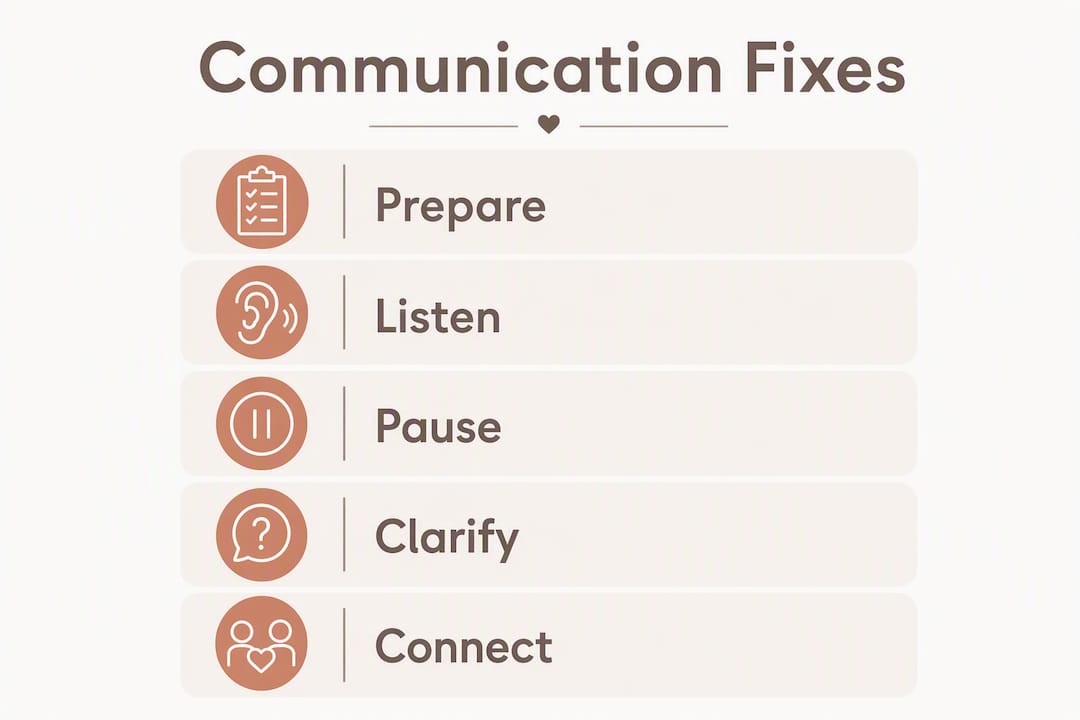
- Daily habits that make everyday conversations reliably easier
- How to manage a conversation when emotions run high
- When neurodiversity, ADHD, or mental health make communication harder
- Treat communication as a system, not a personal failure
- Practice exercises and scripts to build smoother conversations
- Key Takeaways
- Reframing misunderstandings — what changed when I stopped taking them personally
- Pingher makes daily appreciation low-friction and consistent
- Useful research and further reading
Why daily communication is so difficult, explained by psychology
The honest answer is that talking to another person is one of the most cognitively demanding things you do all day, and most of us treat it like it should be effortless.
Communication requires simultaneous operations: listening, decoding what was said, predicting where the sentence is going, planning your response, editing that response before it leaves your mouth, and regulating whatever emotion the conversation is triggering. Failure at any single step produces a breakdown. You were not distracted — you were overloaded.

The 900-millisecond problem
Human conversational planning requires roughly 900 milliseconds to prepare a reply. Many conversational turns happen faster than that. The result is incomplete responses, missed nuance, and the persistent feeling that you said something slightly off from what you meant. Speed is not a virtue in conversation; it is usually the source of the problem.
Statistic: In studies of medical handovers, the second clinician failed to grasp the main point roughly 60% of the time — even between trained professionals communicating about a shared patient. If experts miss the point that often, the bar for everyday conversation is lower than most people assume.
The curse of knowledge
Once you know something, you struggle to imagine not knowing it. You omit context because it feels obvious to you. Your listener hears a sentence stripped of the background that makes it make sense. This is not arrogance — it is a cognitive bias baked into how memory works. The fix is deliberate: state the context you almost skipped.
Emotional activation and threat responses
When a conversation feels threatening — criticism, conflict, uncertainty — your brain shifts resources away from language processing. You lose access to nuance, your listening narrows, and you start scanning for exits or counterattacks rather than meaning. This is why the worst misunderstandings happen in the conversations that matter most.

Environmental and technological contributors
Notifications fragment attention in ways that feel minor but compound quickly. A message read mid-conversation, a phone face-up on the table, background noise — each one pulls processing capacity away from the person in front of you. Channel mismatch adds another layer: a complex emotional topic handled over text loses tone, timing, and the ability to repair in real time.
| Cause | How it shows up | Quick fix |
|---|---|---|
| Cognitive overload | Incomplete replies, missed details | Slow down; one idea per message |
| Curse of knowledge | Omitted context, confused listener | State the background you almost skipped |
| Emotional activation | Defensive responses, poor listening | Pause before replying; name the feeling |
| Mismatched codes | Different assumptions and terminology | Align on shared terms explicitly |
| Channel mismatch | Tone lost, repair impossible | Match channel to message complexity |
| Distraction/notifications | Fragmented attention | Phone away; one conversation at a time |
Pro Tip: Before any important conversation, ask yourself: “Does this person have the same background I do on this topic?” If the answer is “probably not,” spend 30 seconds giving them that context before making your main point.
Good intentions still cause misunderstandings — here’s why
Most communication problems are not caused by bad intentions. They are caused by patterns so familiar you stop noticing them.
The closeness-communication bias
Research on close relationships consistently shows that familiarity does not produce accuracy — it produces overconfidence. The more you know someone, the more you assume they understand you without explanation. Partners, close friends, and longtime colleagues are often the people you explain yourself to least, and misunderstand most. The fix is counterintuitive: treat familiar people with the same care for context you would give a stranger.
Reply-to-win and the fix-it reflex
Two patterns show up constantly in daily friction. The first is replying to win: you stop listening once you have your counterpoint ready, which means you are responding to a version of what was said rather than what was actually said. The second is the fix-it reflex: someone shares a problem and you immediately offer a solution, skipping the step where they needed to feel heard first. Both patterns come from good intentions. Neither lands that way.
A short example: Your partner says, “I’ve been exhausted all week.” You say, “You should go to bed earlier.” What they wanted: acknowledgment. What they got: a prescription. The conversation stalls not because you were wrong, but because you answered a different question than the one being asked.
A small change: “That sounds rough — what’s been the hardest part?” One question instead of one answer. The conversation opens instead of closing.
“The biggest communication problem is we do not listen to understand. We listen to reply.” This observation, widely attributed to Stephen Covey’s work on habits and effectiveness, captures the core of why even well-meaning exchanges go sideways.
Pro Tip: When someone brings you a problem, try a 10-second rule: wait 10 seconds before responding. Use that time to ask yourself, “Do they want a solution, or do they want to feel heard?” The answer changes what you say next.
Daily habits that make everyday conversations reliably easier
These are not communication “tips” in the abstract. They are specific rules you can apply starting today.
-
One idea per message. When you text or email, limit each message to a single point. Multi-part messages get partial replies because the reader answers the easiest part and forgets the rest. If you have three things to say, send three short messages or schedule a call.
-
State your context first. Before your main point, give one sentence of background. “I’ve been thinking about this since our conversation Tuesday — I think we need to revisit the timeline.” That sentence does more work than the main point itself.
-
Use “I” statements for anything emotionally loaded. “I felt sidelined when the decision was made without me” lands differently than “You never include me.” The first describes your experience; the second assigns blame. Even when you are right, blame triggers defense.
-
Match the channel to the message. Text is fine for logistics and quick appreciation. A phone call handles tone and nuance. A scheduled conversation is for anything that requires repair, negotiation, or sustained emotional attention. Sending a difficult message over text because it feels easier is usually the reason it gets harder.
-
Ask one clarifying question before assuming. “What did you take from that?” or “Did that land the way I meant it?” takes five seconds and prevents the kind of misunderstanding that festers for days.
-
Build a micro-ritual for daily check-ins. A predictable, low-stakes channel for daily connection — a morning message, a brief end-of-day exchange — reduces the pressure on any single conversation to carry everything. Small, repeatable rituals do more for communication health than occasional long talks.
Short scripts you can use today:
- Request: “I need about 10 minutes to talk through something — when works for you today?”
- Correction: “I think I explained that badly earlier. What I meant was [X]. Does that make more sense?”
- Appreciation: “I noticed [specific thing] today and I wanted to say it mattered.”
A short daily practice routine:
- Morning: Send one specific, low-friction message of appreciation or connection
- Before any important conversation: 30-second context check (do they have the background?)
- After any friction: one repair question (“Did I miss something in what you were saying?”)
- Evening: one-line reflection — what worked, what you would change
How to manage a conversation when emotions run high
High-emotion conversations are where communication skills go to die. The goal is not to stay calm — it is to buy enough time for your brain to come back online.
The time-out script
When you feel the conversation escalating past the point where you can think clearly, say this: “I want to keep talking about this, but I need 20 minutes to settle down so I can actually hear you. Can we pick this back up at [specific time]?”
Two things matter here: you name a return time (so it does not feel like avoidance), and you frame it as wanting to engage better, not escape. Leaving without a return time is withdrawal. Leaving with one is repair.
A quick grounding exercise
Before you re-enter the conversation, try box breathing: four counts in, four counts hold, four counts out, four counts hold. Repeat three times. This is not a wellness cliché — it directly reduces physiological arousal, which is what narrows your language access and listening capacity in the first place.
Repair phrases that actually work
These phrases work because they shift the frame from combat to collaboration. You are not conceding the argument — you are reopening the channel. Heartfelt communication in couples depends less on saying the right thing and more on creating the conditions where the right thing can be heard.
When to pause vs. when to schedule
A brief pause (20–30 minutes) works when the issue is acute and both people are willing to return. Schedule a longer conversation when the topic is recurring, when one or both people need preparation time, or when the same argument has happened more than twice without resolution. Recurring friction is a systems problem, not a bad-day problem.
When neurodiversity, ADHD, or mental health make communication harder
For many people, the standard advice about communication assumes a neurotypical baseline that does not apply to them. ADHD, anxiety, autism, and sensory sensitivities change the bandwidth and timing of conversation in ways that are real, not personal failures.
ADHD commonly affects attention regulation, conversational timing, and social processing. Someone with ADHD may interrupt not from disrespect but because the thought will be gone in three seconds. They may miss a key point not from indifference but because a background noise pulled their attention at the wrong moment. Anxiety can produce over-explanation, avoidance, or a freeze response mid-sentence. Sensory sensitivity can make a noisy environment so cognitively expensive that there is nothing left for the conversation itself.
Practical accommodations that reduce friction
Structured channels and written follow-ups reduce friction significantly for neurodivergent people. Specific accommodations that work:
- Written summaries after verbal conversations (“Here’s what I heard us agree on”)
- Pre-shared agendas before important discussions, so processing time is available in advance
- Quieter environments for anything emotionally or cognitively demanding
- Explicit permission to pause and process (“Take your time — I’m not in a rush”)
- Shorter, more frequent check-ins instead of long, dense conversations
When to seek professional support
Red flags that suggest coaching or clinical support would help: communication difficulties that persist across all relationships despite genuine effort, patterns that cause significant distress or relationship damage, or a sense that your brain processes conversation in a fundamentally different way than the people around you. Asking for support sounds like: “I’ve noticed I struggle with [specific pattern] — can you help me figure out whether there’s a better approach?”
Common questions about neurodiversity and communication
Does ADHD cause communication problems in adults? Yes. ADHD affects attention, impulse control, and working memory, all of which directly shape how conversations unfold. Timing, listening, and staying on topic are the most commonly affected areas.
Can anxiety make it hard to communicate clearly? Anxiety often produces over-preparation, avoidance of difficult conversations, or a freeze response under pressure. Grounding exercises and written preparation help reduce the physiological load before high-stakes exchanges.
Is it reasonable to ask for accommodations at work? Entirely. Requesting written agendas, follow-up summaries, or quieter meeting spaces is a practical adjustment, not a special favor. Most workplaces respond well when the request is framed around what helps you do your best work.
Treat communication as a system, not a personal failure
The most useful reframe in communication research is also the least intuitive: communication failures are system failures, not character flaws. When a conversation goes wrong, the question is not “what is wrong with me?” but “what in this system made that outcome likely?”
A communication system includes the people involved, the channel they are using, the norms they have built, and the context each person is carrying. Change any one of those variables and the outcome changes. This is not a soft idea — it is the reason the same two people can have a terrible conversation on a Tuesday night and a productive one on a Saturday morning. The people did not change. The system did.
Three questions to audit any conversation
- Who holds the context? Does your listener have the background that makes your message make sense, or are you assuming they do?
- Does the channel fit the message? Is this the right medium for what you are trying to say, or are you using it because it is convenient?
- What assumptions are required? What does your listener need to believe or know for your message to land as intended?
A small fix and its expected effect
One of the highest-return system changes is the pre-brief: a single sentence before a difficult conversation that sets the frame. “I want to talk about something that’s been bothering me — I’m not looking for a solution, just to think out loud with you.” That sentence changes what the listener is listening for, which changes everything that follows.
Each person brings private shorthand, assumptions, and terminology to every conversation. Improving alignment requires explicitly creating shared terms, not assuming they already exist.
Pro Tip: Keep a simple log for one week: after any conversation that went sideways, write one sentence about what in the system made it likely (wrong channel, missing context, wrong time). After seven days, you will see patterns that no amount of “try harder” would have revealed.
Practice exercises and scripts to build smoother conversations
Improvement in communication is not about insight — it is about repetition. Here is a compact one-week practice plan.
The 3:2:1 rule
Before any significant conversation, run this check:
- 3 — What are the three things I want this person to understand?
- 2 — What are the two things I need to hear from them?
- 1 — What is the one outcome I am hoping for?
This takes 90 seconds and prevents the most common failure mode: entering a conversation with a vague intention and leaving with a vague result. A short example: instead of “I need to talk to my partner about feeling disconnected,” you get “I want them to understand I miss our evenings together (1), that I’m not blaming them (2), that I’m not sure what’s causing it (3) — and I want to hear whether they feel it too (1 thing I need from them) — and I want us to agree on one small change (the outcome).”
A one-week practice plan
- Day 1: Send one specific appreciation message to someone you communicate with daily. Make it concrete (“I noticed you handled that situation patiently — it made a difference”).
- Day 2: Before your next important conversation, run the 3:2:1 check and write it down.
- Day 3: Practice the 10-second rule in one conversation — wait before responding and ask yourself what the other person actually needs.
- Day 4: After a conversation that felt off, write one sentence identifying the system variable that contributed (channel, context, timing, emotional state).
- Day 5: Use one “I” statement in a conversation where you would normally have used “you.”
- Day 6: Try a daily check-in ritual — a short, predictable message at the same time each day.
- Day 7: Review your log. What pattern shows up? What one change would address it?
Three ready-to-use scripts
- Making a request: “I have something I’d like to talk through — it’s not urgent, but it matters to me. Can we find 15 minutes this week?”
- Offering a correction: “I think I gave you incomplete information earlier. The full picture is [X] — I should have said that upfront.”
- Expressing appreciation: “I want to name something specific: when you [did X], it made me feel [Y]. Thank you.”
Journaling prompts for tracking progress
After any conversation worth reflecting on, write answers to: What did I assume they already knew? What did I hear versus what was said? What would I do differently? Progress in communication is almost always invisible until you track it — small wins compound, but only if you notice them.
Key Takeaways
Daily communication is difficult because it is a real-time, resource-limited system — and fixing it means changing the system, not just trying harder.
| Point | Details |
|---|---|
| Cognitive load is the root cause | Your brain runs six operations at once in conversation; overload at any step produces a breakdown. |
| Familiarity breeds overconfidence | Close relationships suffer most from assumed shared context — treat familiar people with the same care for context as strangers. |
| Slow down and ask one question | The 900-millisecond planning constraint means speed is usually the problem, not the solution. |
| Audit the system, not yourself | Ask who holds the context, whether the channel fits, and what assumptions your message requires. |
| Pingher reduces daily friction | Pingher’s one-tap messages, templates, and scheduling make low-friction daily appreciation and check-ins a repeatable habit. |
Reframing misunderstandings — what changed when I stopped taking them personally
The conventional advice on communication tends to focus on skills: listen better, speak more clearly, choose your words carefully. That framing is not wrong, but it puts all the weight on the individual, which means every misunderstanding becomes evidence of a personal shortcoming. That is exhausting, and it is not accurate.
What actually shifted my understanding of this was treating a recurring argument not as a failure of effort but as a design flaw. The same conversation kept going sideways at the same point — not because either person was being unreasonable, but because one person always entered it with context the other did not have. Once that was visible, the fix was obvious and small: a single sentence of background before the main point. The argument did not happen again.
The research supports this. Viewing communication as a systems problem rather than a personal failing reduces shame and focuses attention on the variables that are actually changeable: context, channel, timing, and shared norms. You cannot will yourself into being a better listener when you are cognitively overloaded. You can change when and where the conversation happens.
If you have been frustrated by repeated misunderstandings, that frustration is valid. Communication is genuinely hard — not because you are doing it wrong, but because it requires two minds to build shared meaning in real time under conditions that work against it. The goal is not perfection. It is a slightly better system, practiced consistently, until the friction reduces enough to matter.
Pingher makes daily appreciation low-friction and consistent
The hardest part of daily communication in relationships is not knowing what to say — it is remembering to say it when life is moving fast. Pingher is built for exactly that gap: the moment you want to send something warm and specific to your partner but the day has already run away from you.
Where most messaging apps put the burden on you to find the words, Pingher offers AI-powered suggestions, ready-to-use templates, and one-tap sending so a thoughtful message takes seconds, not minutes. You can schedule messages in advance, set reminders for important dates, and build the kind of predictable daily check-in ritual that communication research consistently identifies as the highest-return habit for relationship health. The features map directly to the systems fixes in this article: low barriers, predictable channels, and reduced memory load.
If you want to put the daily appreciation habit on autopilot, try Pingher and see how much lighter the daily communication load feels when the tools are working with you.
Useful research and further reading
| Source | What it adds |
|---|---|
| 6 Barriers to Effective Communication — Drexel University | Covers the core categories of communication barriers with workplace context; a solid starting point for understanding why breakdowns are structural, not just personal. |
| Effective Communication: Improving Your Interpersonal Skills — HelpGuide | Practical, clinically grounded guidance on active listening, emotional regulation, and repair; one of the most accessible resources for applying the concepts in this article. |
| Why Communication Breaks Down — INSEAD Knowledge | Explains mismatched individual “codes” and the need for explicit alignment; useful for anyone working on communication in close or professional relationships. |
| The Illusion of Understanding — The Observer | Covers the 900-millisecond planning constraint and the medical handover research; the most evidence-dense source in this list for the cognitive mechanics of conversation. |
| Why Can’t People Understand Each Other? — Psychology Today | Research-backed discussion of misunderstanding in close relationships; directly relevant to the closeness-communication bias covered in this article. |
| ADHD and Communication Difficulties in Adults — ADHD Centre | Clinical overview of how ADHD affects conversational timing, attention, and social processing; the most specific resource for the neurodiversity section. |
Follow one or two of these for deeper reading — the INSEAD piece and the Observer article together give the clearest picture of why communication fails even when both people are trying.
Recommended
Built for couples who care.
Pingher helps you send the right words at the right moment.
Get Pingher on Google Play